The Scream of Mother Earth by Omer Gielliet is no more. Removed and destroyed by the municipality of Amsterdam. The wood of the award-winning wooden sculpture in the town of Weesp ‘was rotten and cracked’. A pity that of this groundbreaking sculpture nothing more than some photos have been preserved.
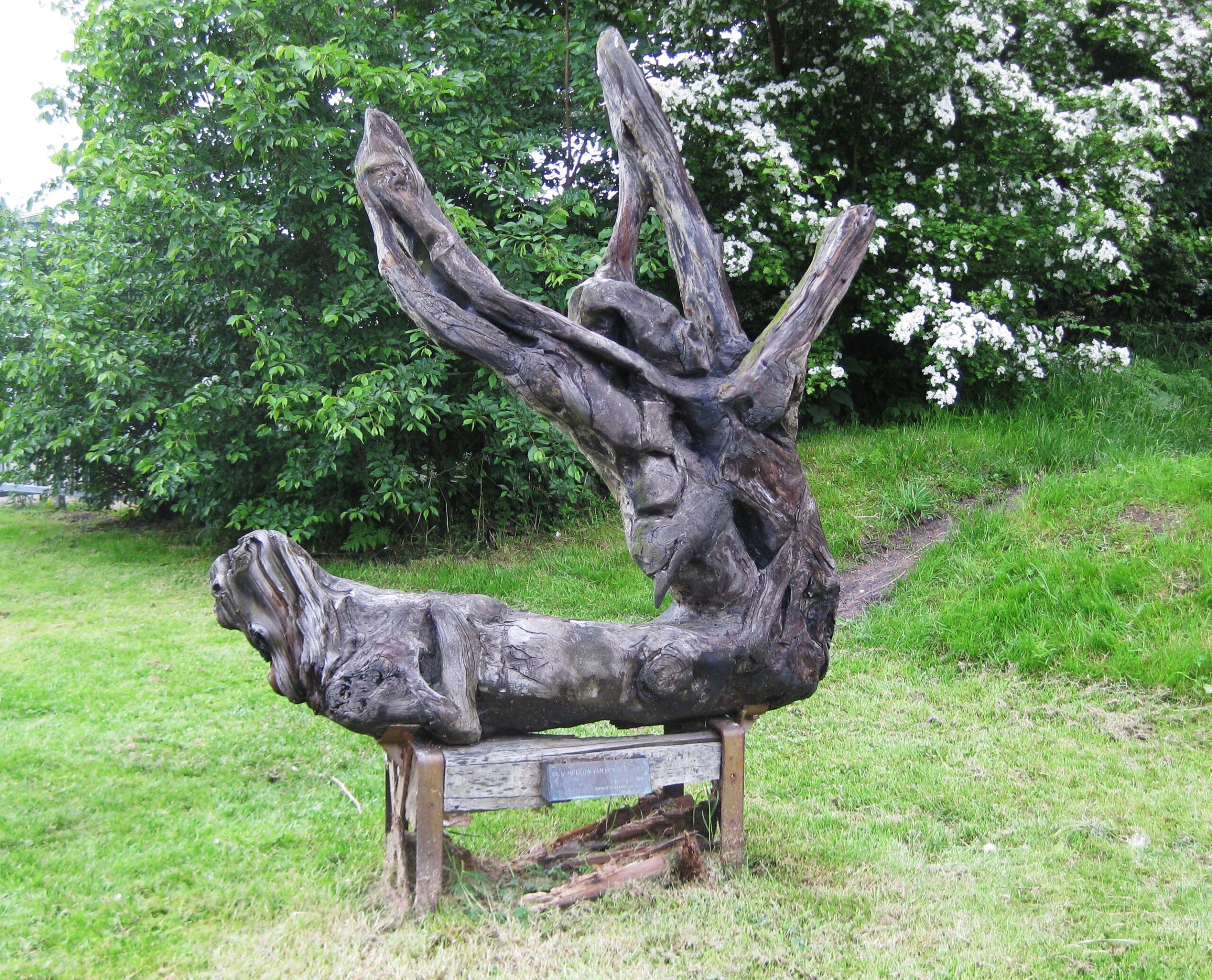
‘The Scream of Mother Earth’ is no more; this wooden sculpture by Omer Gielliet has been destroyed. (Photo: Marion Golsteijn / Wikipedia)
The future always already exists, even if only a little. Look at the sculptures that the priest/sculptor Omer Gielliet (1925 – 2017) from Breskens made. This pioneer can retrospectively be counted as a proto-Dendroist. It is the new art movement where the grain of the wood and the shape of a tree is the starting point for the artist’s work. That is exactly what Gielliet wanted: “Look, what do you see in there?”
As a schoolboy I was already amazed by his sculpture in the education center Hedenesse, near the coastal town of Cadzand in Zeeuws-Vlaanderen. There on the wall hung an enormous root stump, worn away by tidal currents. That this enormous stump was by Gielliet, I only found out now, half a century later.

The sculpture ‘Vaart’ by Omer Gielliet, which hung in the former education center Hedenesse half a century ago.
I have never forgotten the sculpture, but to see it again will be difficult. Hedenesse has changed owners several times since the 1980s. In the current group accommodation Cadzandië, Gielliet’s enormous piece of driftwood no longer hangs.
“Rotten and cracked”
In search of perhaps his very finest creation, ‘The Scream of Mother Earth’, I discovered that this award-winning sculpture (Environmental Prize 1992) also no longer physically stands in Weesp – and only continues to exist on the website of this town. Upon inquiry, the municipality emailed me that the sculpture “was removed and destroyed four years ago (in 2021) because it was in very poor condition. The wood was rotten and cracked and the base was rusted through. Unfortunately therefore also no longer somewhere in storage.” The Scream of Mother Earth has thus disappeared into eternity. Only photos are all that remains of it.
It is not the first time this happened to an outdoor sculpture by Gielliet. The humid Dutch climate is violent for wooden outdoor sculptures. A tree trunk from 1991 by Gielliet along the Westerschelde, which symbolized the Biblical fruit grower Amos, had to be replaced in 2007 with a bronze replica, made by the artist Eric Odinot from Zierikzee.
“I saw myself in that blown-off branch”
Gielliet’s artistry began when he was deeply depressed. On a walk in the area around his little church in Zeeuws-Vlaanderen he made the discovery of his life, he said in an interview. “A branch had blown off. Total Loss. It was nothing anymore. I saw myself in it. I saw a little man with his arms in the air. That’s how I felt too, as in a deep valley, a spiritual valley. I went home, and with a potato peeler I started carving that branch. To say: this is how I feel. And that’s how it actually started. I felt like I had found a spring, whereas before I only drank from the tap. And that spring turned out to be inexhaustible; was full of ideas. I kept drawing from it.”
Indeed a production flow started, which not only filled his own little church, but also numerous other spiritual and non-spiritual places. In an interview Gielliet explained: “I have something with wood. There is a secret in it. Every little cell that dies in a tree to let the next one live.”
“Wood, there is a secret in it”
But also his overwhelming creative urge was initially driven by anger. He found his little church in Breskens neat but ‘so terribly boring’. His new hobby brought some joy of life. But it did result in a remark from a churchgoer, as if he was leading a nice life with the collection money from the faithful. Gielliet approached the man after the church service and said: “From now on I don’t need your money anymore. I will earn it myself.”
Gielliet, looking back in an interview: “And I started living from that wood carving. I could buy things with it. One person wanted something and another wanted something. And I could live from it and tell something that had never been done before. And at some point the Belgians also came to look, with busloads.” In Zeeland dialect: “Unbelievable, isn’t it.”

The sculpture ‘Consecration’ in Gielliet’s little church in Breskens: ‘Beloved with your wide arms open’.
Around ‘his’ little church numerous sculptures still stand, which sometimes seem somewhat clumsy. Primitive. But as soon as the wood tells the story itself, the magic begins. From a large round-sawn root system in the front garden of the church, a bird’s head protrudes, making the bird appear to be flying away.
It is a pity that the memory of this special Dutch pioneer in modern wood carving also fades so quickly. That must not happen. Fortunately I found an old copy of that self-published booklet ‘Resurrection of the Trees’, which is sometimes still offered for sale in second-hand bookshops. It contains an overview of his works, including the sculptures that are safely exhibited under a protective roof, away from the elements.
One last text by Gielliet about his work and thought process, after finding driftwood along the coast: “A dumb piece of wood. Already eloquent with its burn marks and holes and seams and mud. You take it with you and look at it a thousand times. Until finally everything disappears and becomes still and you ‘hewing and carving’ find the things of which you have the feeling that they are timeless and yet contemporary, fragments of life that nevertheless permeate all of life.”
Jan Bom, February 19, 2025