Michelangelo masterful wooden Christ was carved from linden wood when he was only eighteen years old. His “Lost Christ” hangs in the Basilica di Santo Spirito in Florence. The future master of the Renaissance created this remarkable sculpture after studying real human corpses.
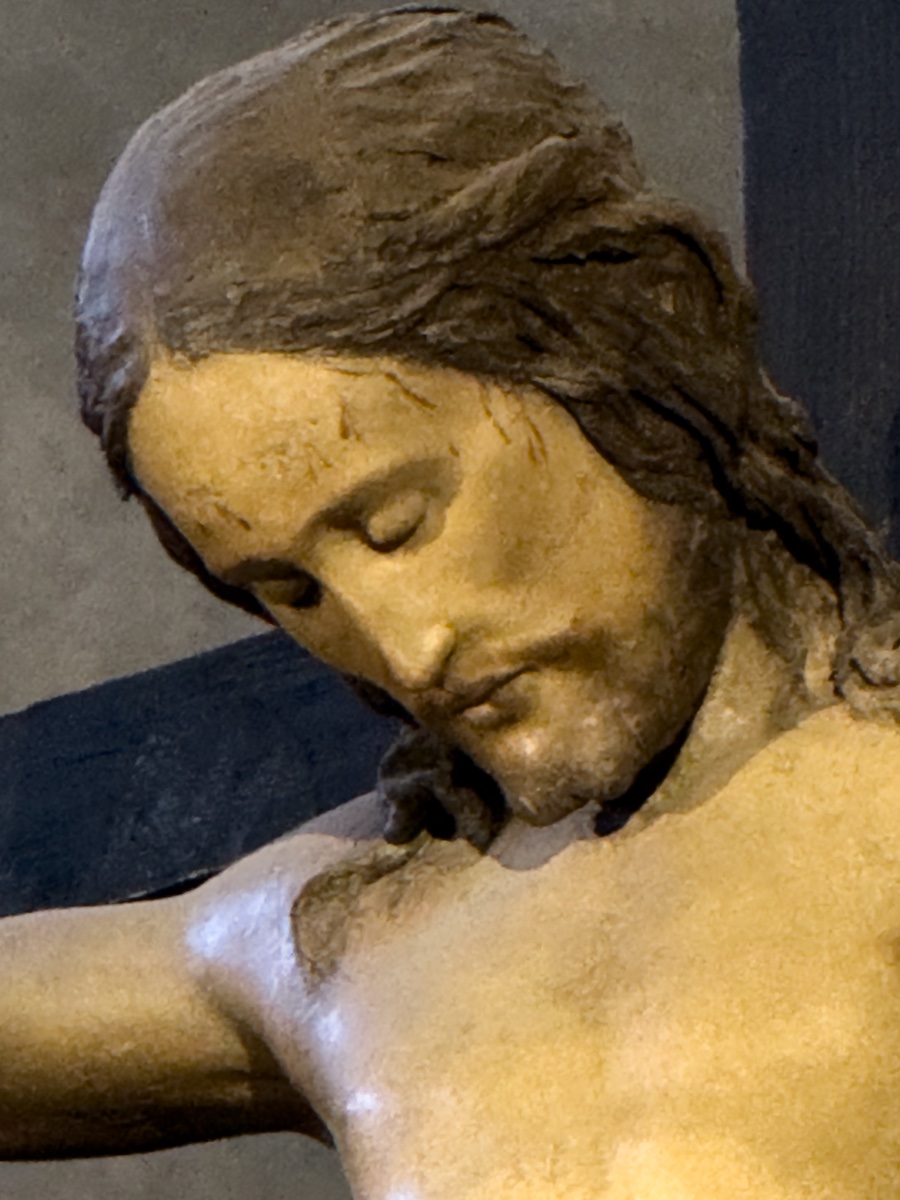
Michelangelo’s Masterful Wooden Christ, rediscovered in 1962.
The title “The Lost Christ” could hardly be more misleading. “The Rediscovered Christ” would be far more appropriate. The sculpture was only rediscovered in 1962 after having disappeared from view for centuries.
It was the German art historian Margrit Lisner who rediscovered the sculpture in 1962. A specialist in Tuscan crucifixes, she wandered into the Basilica di Santo Spirito on a day when she simply did not feel like working in the library. She struck up a conversation with the Augustinian prior, who mentioned that there was an old crucifix hanging somewhere in the monastery. There, above the doorway to the old rectory, hung the completely nude figure of Christ. Lisner immediately recognized Michelangelo’s hand, despite the fact that it was an early work.
Hidden in the old rectory
Other art historians soon confirmed that the sculpture could only have been carved by Michelangelo.
Today the crucifix occupies a prominent place in the church’s sacristy. Despite its modest size, it could hardly be displayed more dramatically. Rather than hanging against a wall, it is suspended in the middle of the room from a rod that descends some twenty metres from the ceiling. Because the sculpture is small and completely nude, it conveys a sense of loneliness and vulnerability, as if Christ himself has been abandoned. Forgotten. A remarkable association for a sculpture that remained hidden for centuries, unseen by the countless visitors who come to Florence to admire Michelangelo’s David and his other masterpieces.
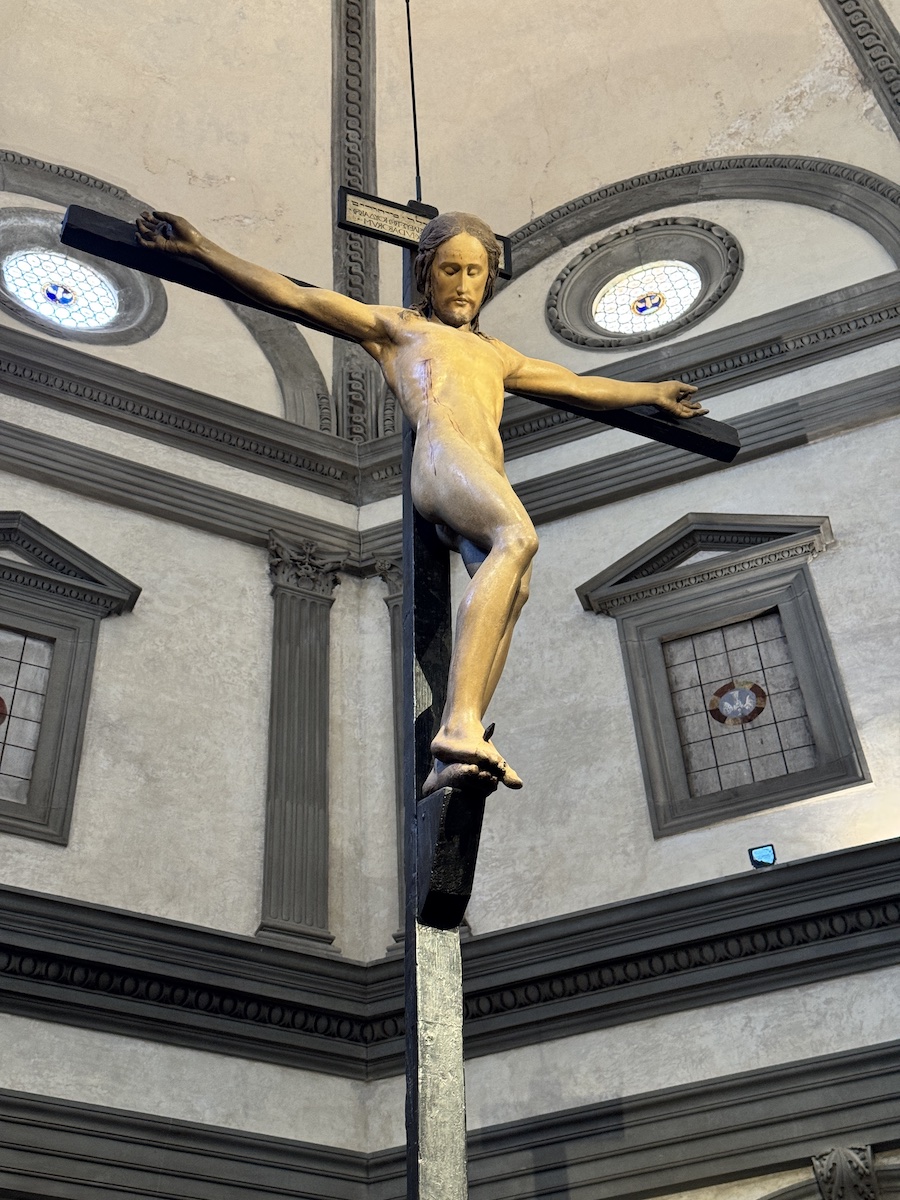
The work of a gifted young apprentice named Michelangelo di Lodovico Buonarrotti Simoni.
Michelangelo belongs to the long tradition of artists who began their careers as woodcarvers. The Santo Spirito Crucifix is the only surviving wooden sculpture that can be attributed to him with certainty.
Michelangelo was probably about eighteen years old when he carved this crucifix. Young, certainly, but far from inexperienced. He most likely completed the work in 1493, after the death of Lorenzo de’ Medici in 1492 and before leaving Florence for Bologna in 1494.
Introduced by de’ Medici
Lorenzo de’ Medici was the ideal Renaissance prince: diplomat, banker, collector, political strategist, notorious womanizer and one of the greatest patrons of the arts. By the late 1480s Florence had remarkably few great sculptors left. Brunelleschi and Donatello had long since died, Verrocchio had only recently passed away, and Pollaiuolo was working in Rome. Lorenzo therefore took a gifted young apprentice from the workshop of Domenico Ghirlandaio: Michelangelo Buonarroti (1475 -1564).
Lorenzo and his son Piero maintained close ties with Santo Spirito. It was probably one of them who introduced Michelangelo to the prior of the church, Niccolò di Giovanna. The prior gave the young sculptor perhaps the greatest gift any artist devoted to the human figure could receive: unlimited access to human bodies. To be more precise: the dead. Corpses.
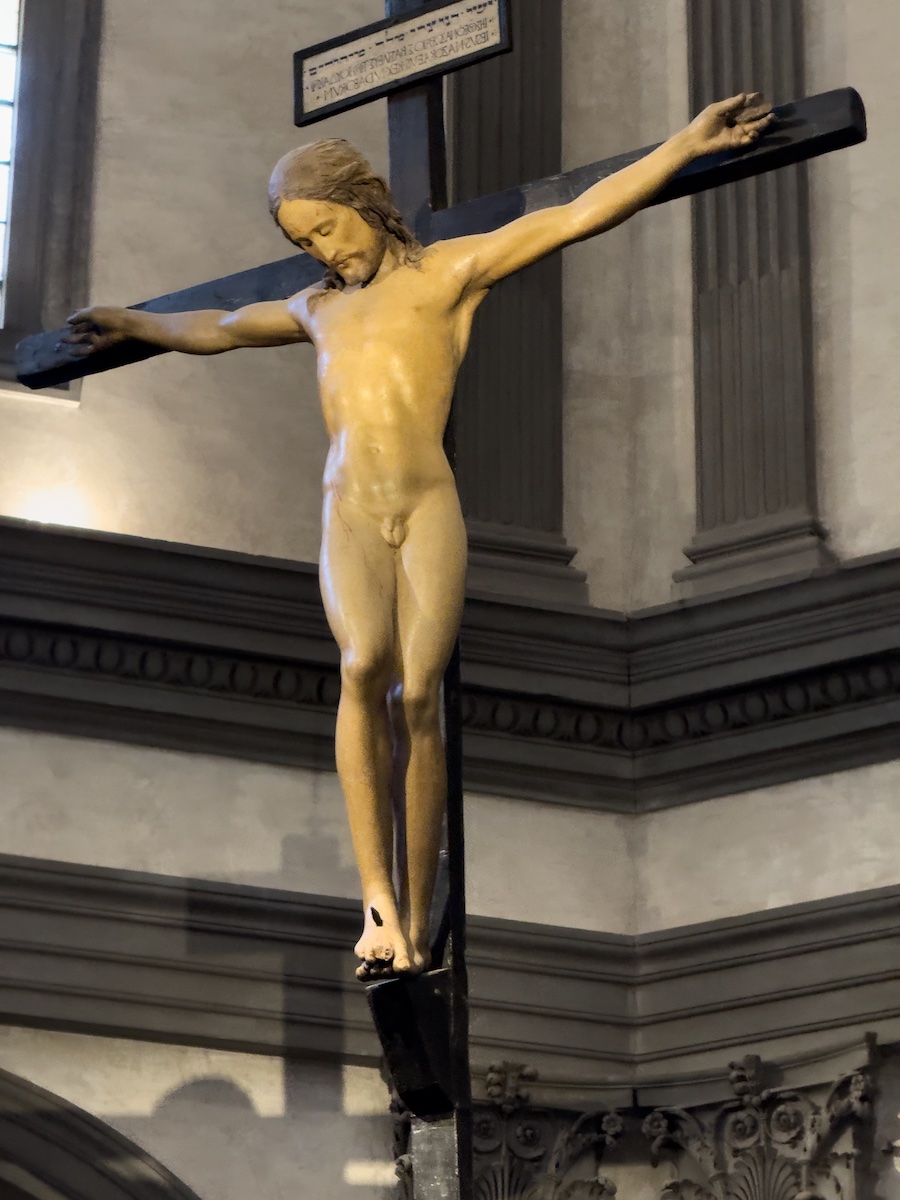
Did a dead young man stood model for this early work of Michelangelo?
Michelangelo was given a room in the convent near the infirmary, where he studied bones, muscles and skin. At the time, anatomical dissection was officially forbidden but quietly tolerated. In gratitude, Michelangelo carved a limewood crucifix for the church’s high altar.
This background is essential. What makes Michelangelo’s Christ so haunting is the contrast between the unmistakable signs of death—the yellowish ivory skin, the blood trickling from the wounds, the hair clinging together like wet brown seaweed—and the almost childlike proportions of the body, with its narrow rib cage and barely developed muscles.
A very different Crucifix
Some of the unusual proportions have been explained by the crucifix’s original position above the high altar. We know this from Michelangelo’s earliest biographers, Ascanio Condivi and Giorgio Vasari. A sixteenth-century drawing showing the crucifix above the original choir also helped establish the sculpture’s authenticity.
There is another reason why the work is so remarkable. Michelangelo’s Christ bears little resemblance to the crucifixes carved by his contemporaries. Even the earlier works of Brunelleschi and Donatello are anatomically more convincing and more conventionally proportioned. Yet they are emotionally less powerful. Michelangelo’s crucifix evokes confusion, attraction, sorrow and compassion all at once.
First signs of chest hair
This Christ appears strikingly young, with the first signs of chest hair. Equally remarkable are the elongated forehead and the soft, almost feminine modelling around the mouth.
By the standards of its own time, the sculpture also seemed anatomically unconventional. For many years it was regarded as somewhat awkward, the work of a talented but still inexperienced young artist. And, to be fair, there is some truth in that. Michelangelo did not attempt to create a life-sized, naturalistic Christ of flesh and blood. Instead, he created a deeply personal, almost intimate devotional vision.
Today, art historians recognize the sculpture for what it truly is: a work in which contradiction, tenderness and mystery come together—precisely the qualities that make the greatest works of art so enduring. Seen from that perspective, Michelangelo’s wooden Christ is nothing less than perfect.
The Basilica di Santo Spirito is located at Piazza Santo Spirito 30, 50125 Florence, Italy, in the lively Oltrarno district.
Jan Bom, July 15, 2026