Ron van der Ende is an illusionist in salvaged wood. The artist transforms panels of only a few centimeters thick into images with an unprecedented spatial depth. It is as if his cars are driving towards you. Boats, houses and landscapes, they seem to protrude at least a meter from the wall.
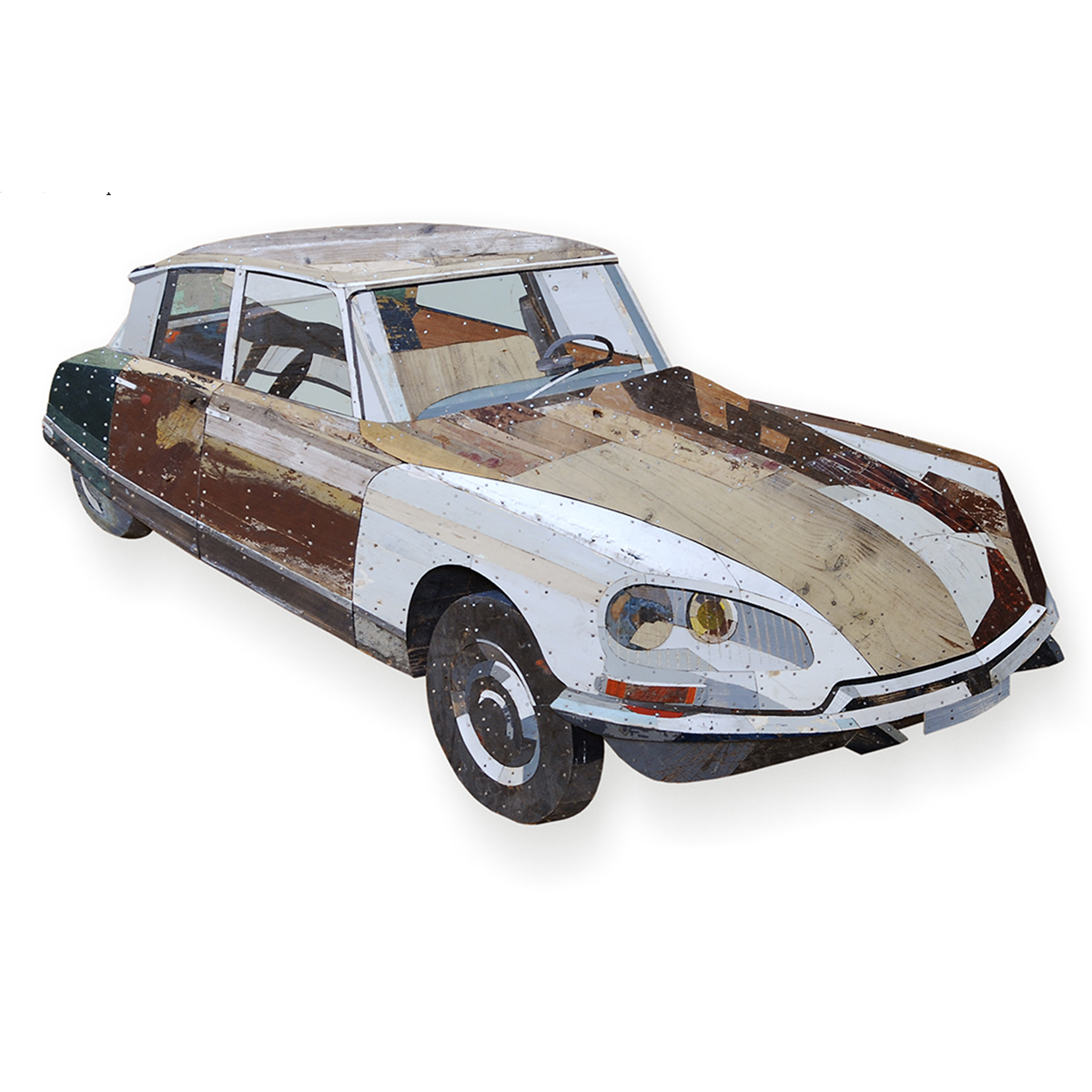
The ‘Snoek’ by Ron van der Ende, the iconic Citroën DS 1.
In his studio, Van der Ende bends over a collection of thin strips of wood, in many shades of weathered blue paint. They just came off the saw table. There is a color photo lying there.
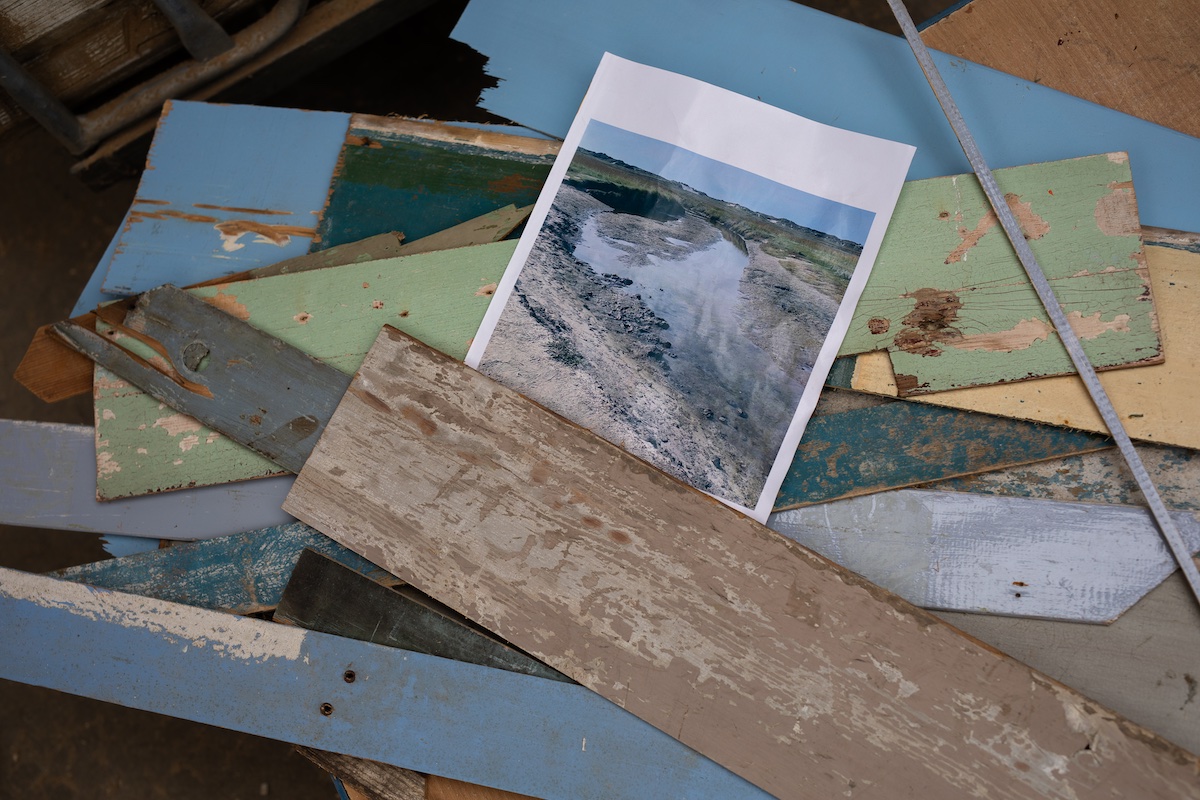
The painter’s palette of Van der Ende, very thinly sawn wood panels with peeling paint.
With these elements he is going to create De Slufter on the island of Texel, at a moment when the North Sea penetrates the dunes at high tide. The sun and clouds will be reflected in the water. “Then I’m going to fool people”, says the artist. He means: later the viewer will stand before the work with the feeling of staring into an open peep box. But it is an optical illusion. Just like the frightening valleys and ravines of his salvaged wood mountain landscapes are no deeper than a fist.
Sold immediately
It is this fabulous imagination with which the artist Van der Ende (1965) created such a sensation that his free work is usually sold before it leaves his workshop in Rotterdam. He works for two months on a single work, which consists of hundreds to thousands of pieces of sawn wood.
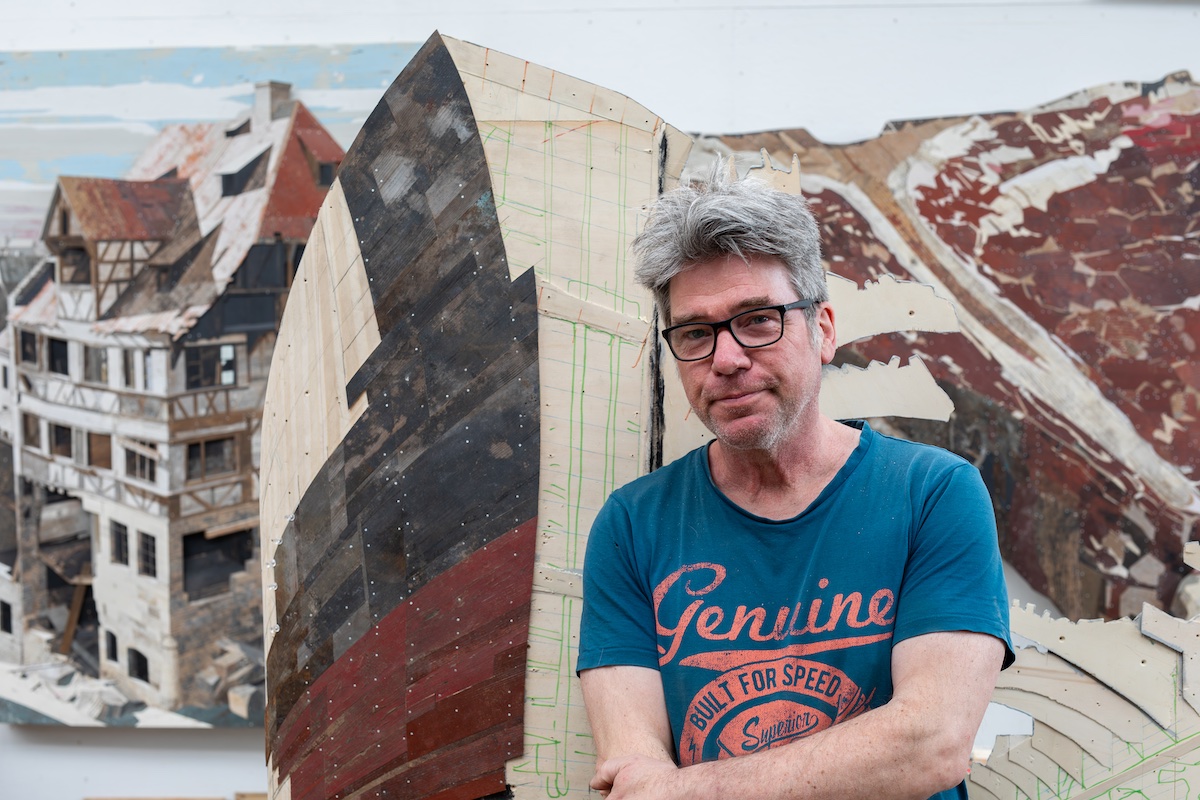
Ron van der Ende in his studio, in front of the construction of a sculpture of a famous shipwreck.
A large part of his studio on the Industrieweg is taken up by his collection of old weathered doors and other pieces of salvaged wood, in all possible colors of peeling paint. It is his painter’s palette. Van der Ende not only saves the wood from burning, but creates added value with it. He saws the old planks to a thickness of slightly more than veneer, after which the construction of perspective begins.
The artist has been making such so-called bas-reliefs, or low-reliefs, since the year 2000. It is a technique that the Egyptians already used to tell their stories. Van der Ende gives it a contemporary twist by aligning with the pursuit of a circular economy with his choice of materials. In it, waste no longer exists, but used raw materials are given a new purpose.
No thicker than 15 centimeters
Van der Ende grew up in the Westland. His father worked at a carpentry factory. This introduced him to woodworking at an early age. He followed his education from 1984 to 1988 at what is now called the Willem de Kooning Academy in Rotterdam.
He tells in his studio how he started making not too large ship models in 1996.
A beautiful anecdote from that period, 1996-1997: “I had also made a series of submarines that hung at the KunstRAI. A major art collector came by, the current owner of Museum Voorlinden in Wassenaar. He looked at them and said: ‘I want to buy four, but I’ll only pay for three…’ We did it. You simply don’t say no to such a collector, because then he’ll never come back.”
Very Rotterdam, averse to any fuss: “I had a lot of success with it but the subjects I could do this way were limited. I wanted to make cars but that was difficult as a fully 3D model. And it was a lot of work. By making it flat, suddenly a lot became possible. In a direct way.”
Four submarines sold at once
His technique developed rapidly. In a series of old wrecked cars (2000-2001) his imagination peaked. Old American sleds came to hang on the wall, in various stages of decay. Van der Ende went even a step further. In the shiny paint and windows of a beautiful Citroën DS 1, he also reflected the surroundings of this ‘Snoek’. Suddenly a mind-boggling art form hung on the wall.
The relief was a fact. From then on, his hanging works would not be much thicker than 15 centimeters at most.
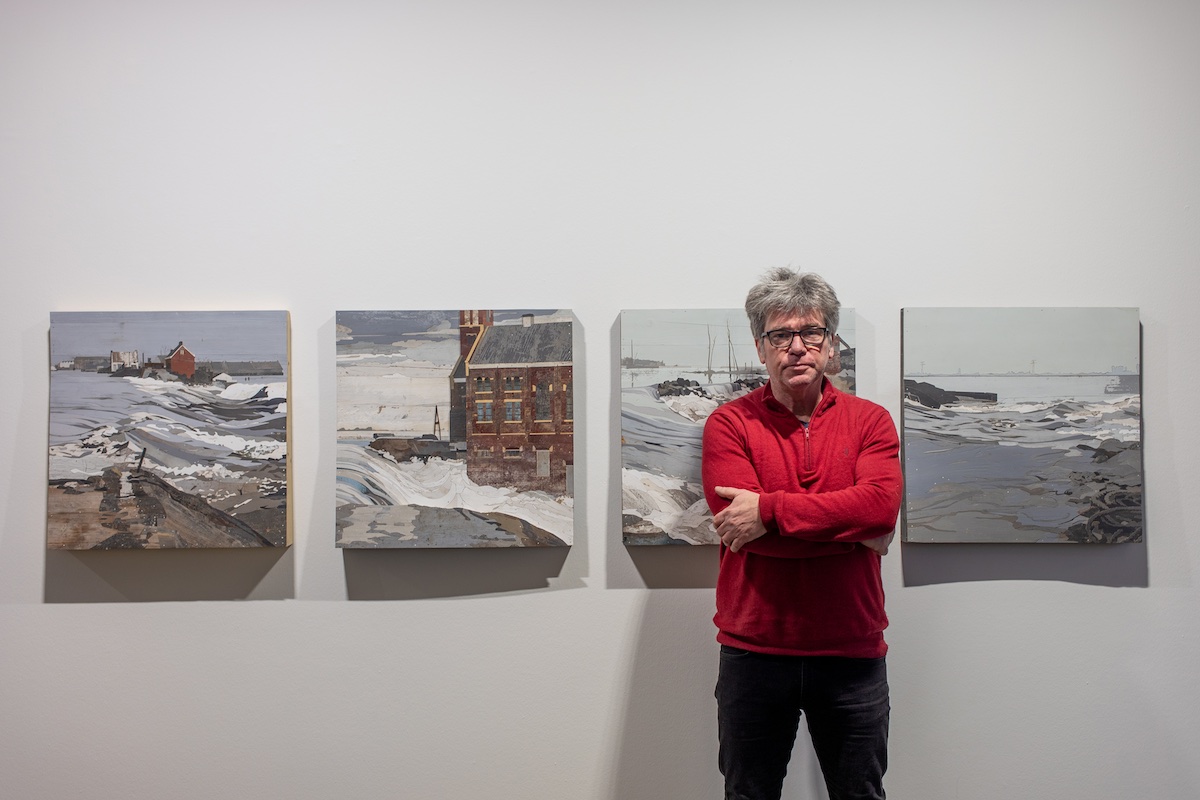
Ron van der Ende in front of his series ‘1953’ about the North Sea Flood, in his gallery Ron Mandos.
It is quite coincidental that Van der Ende and Piet Hein Eek (1967) started working with salvaged wood almost simultaneously. About his peer, who presented a series of ‘salvage cabinets’ as a graduation project at the Design Academy in Eindhoven in 1990: “I saw his cabinets for the first time at the KunstRAI in 1994. I was there with Gallery Delta. My artist collective Expo HenK had built a seven-meter-high ‘Pippi Longstocking house’ on stilts there. Improvised from scaffolding cupboards and salvaged wood. It has now been standing for 30 years in the Sculpture Garden Clingenbosch near Museum Voorlinden. It is still accessible to the public.”
The bombed house of Dürer
In the studio of Van der Ende now hangs an enormous work depicting a typical German half-timbered house. These are houses that show the construction of beams on the outside, with a white-painted filling of other bio-based materials.
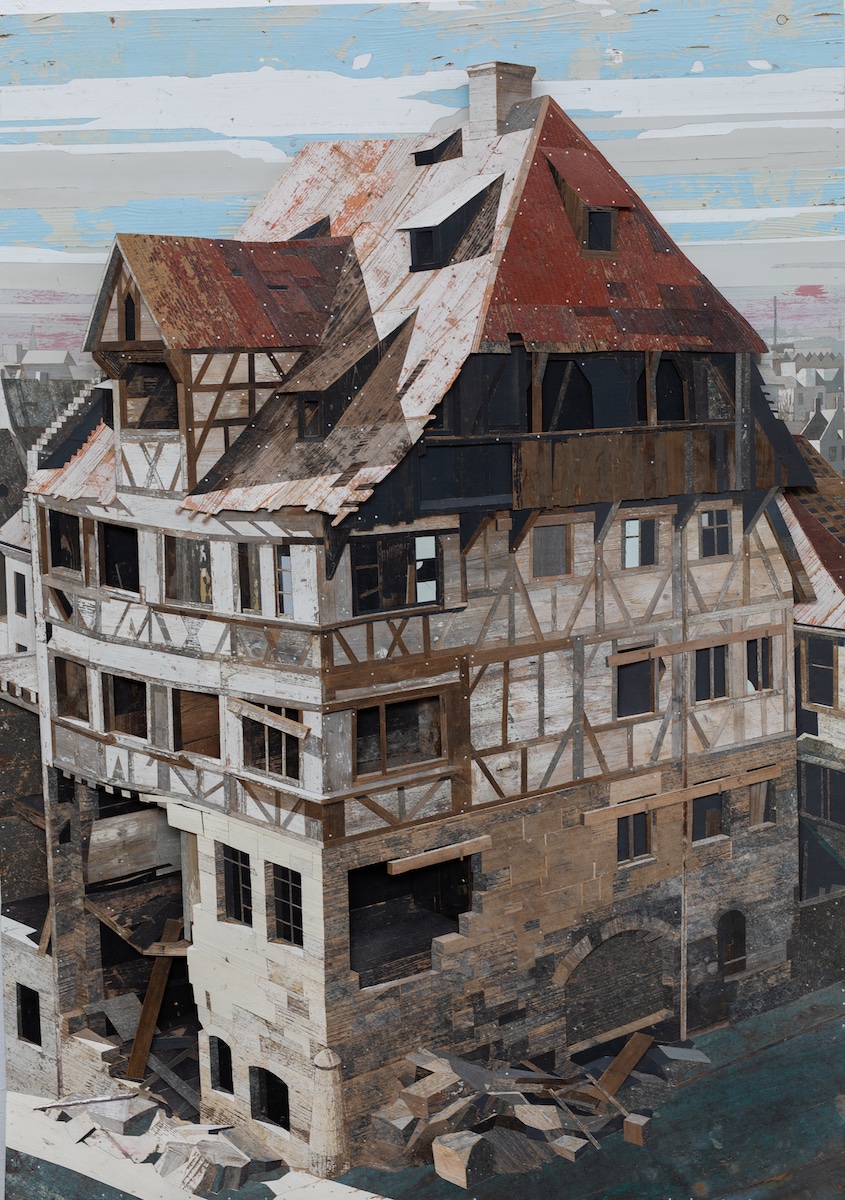
Another illusion by Van der Ende: the bomb-damaged house of Albrecht Dürer. The artwork has since been purchased by the museum located in the birthplace.
Van der Ende chose a very special moment to capture this house of the world-famous German artist Albrecht Dürer (1471-1528) in Nuremberg. He situated the condition of the building towards the end of World War II. The Allies relentlessly bombed German cities to force Hitler’s Nazis to surrender. The house looked like cities in Ukraine or Gaza now, with missing walls and open spaces like black holes in a rotten set of teeth.
He started it as free work, without a client, based on photos and a model house from a toy train set. But… “Interest has already been shown in it. By the museum now located in this building. They had seen on Instagram or Facebook that I had finished it and wanted it. They want to show it in the permanent presentation from 2025.”
The transience of things
The transience of ‘things’ has become a permanent theme in his oeuvre. On his workbench lies the ‘skeleton’ for a work that will depict the carcass of a famous ship. This tanker at the ‘demolition beach’ Gadani in Pakistan made world news in 2016 after it exploded.
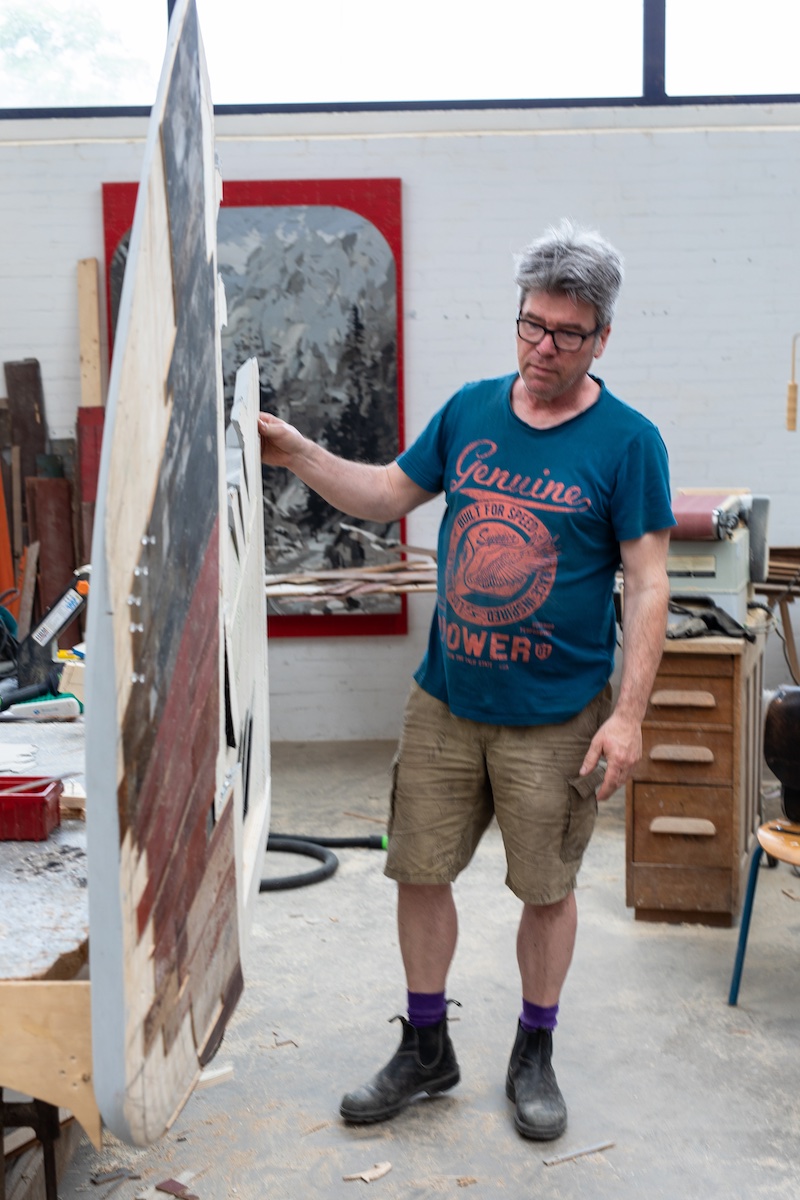
The artworks of Ron van der Ende don’t get thicker than this: here for the design of the monument for deceased ship breakers.
In this accident no fewer than 28 people died. That is an official figure. According to the ship breakers themselves, at least 80 people were killed. It shows Van der Ende’s social engagement. “They hadn’t properly cleaned the tanker beforehand. According to an investigation afterwards, safety protocols were not respected due to high work pressure.” (Probably gas formation occurred in spaces due to the heat. That is very risky when ship breakers have to dismantle a ship with cutting torches, jb).
An illusionist in salvaged wood
How he builds up his technique can be clearly seen in this sculpture-in-progress. For the rusty ship’s hull, he looked for brown peeling pieces of salvaged wood. But how does he still get those thin planks slightly curved? How does he prevent this old, weathered wood from breaking when he nails it to the slightly curved wooden skeleton? Again, sobering Rotterdam-style: “By sawing the strips just a little thinner at the end. And not nailing it, but gluing it.”
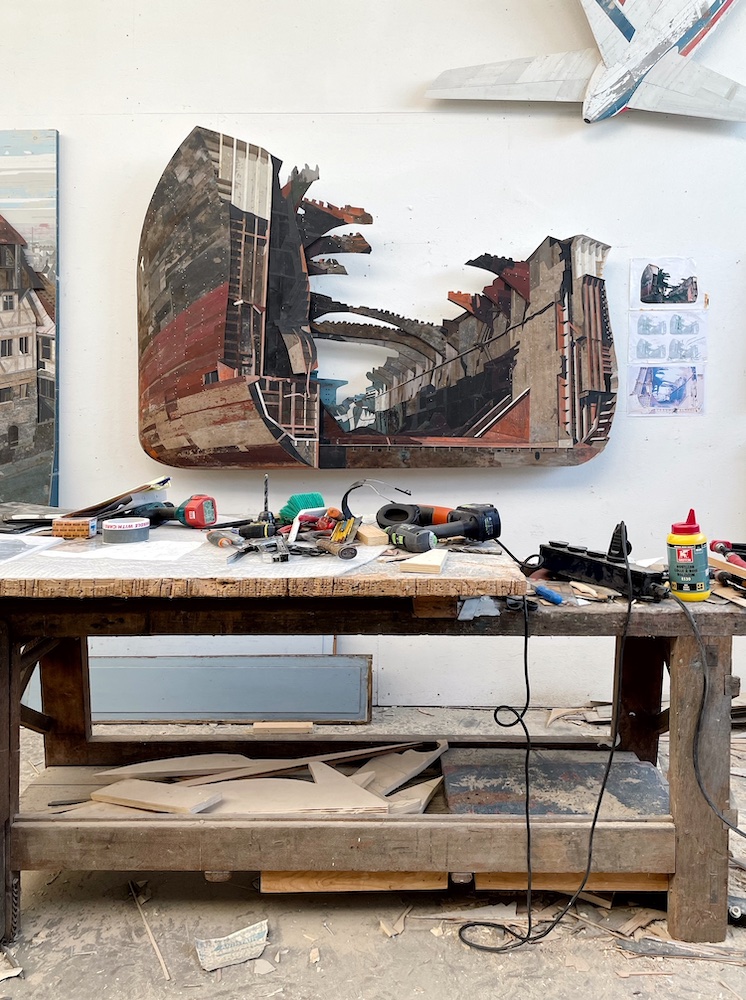
Postscript: The shipwreck by Ron van der Ende is finished. He exhibited it in his studio on the open art day on September 21 (2024) and told visitors that ‘these are our ships that are being demolished there. People found it intense and moving.’
Text Jan Bom