Tapio Wirkkala (1915 – 1985) discovered the rhythm of hollowed-out plywood. The Finnish artist made a 9-meter wall from it, the ‘Ultima Thule’. But he also gave the impetus for what became world-famous Finnish design with commercial utility objects like wooden bowls and dishes for cocktail nuts.
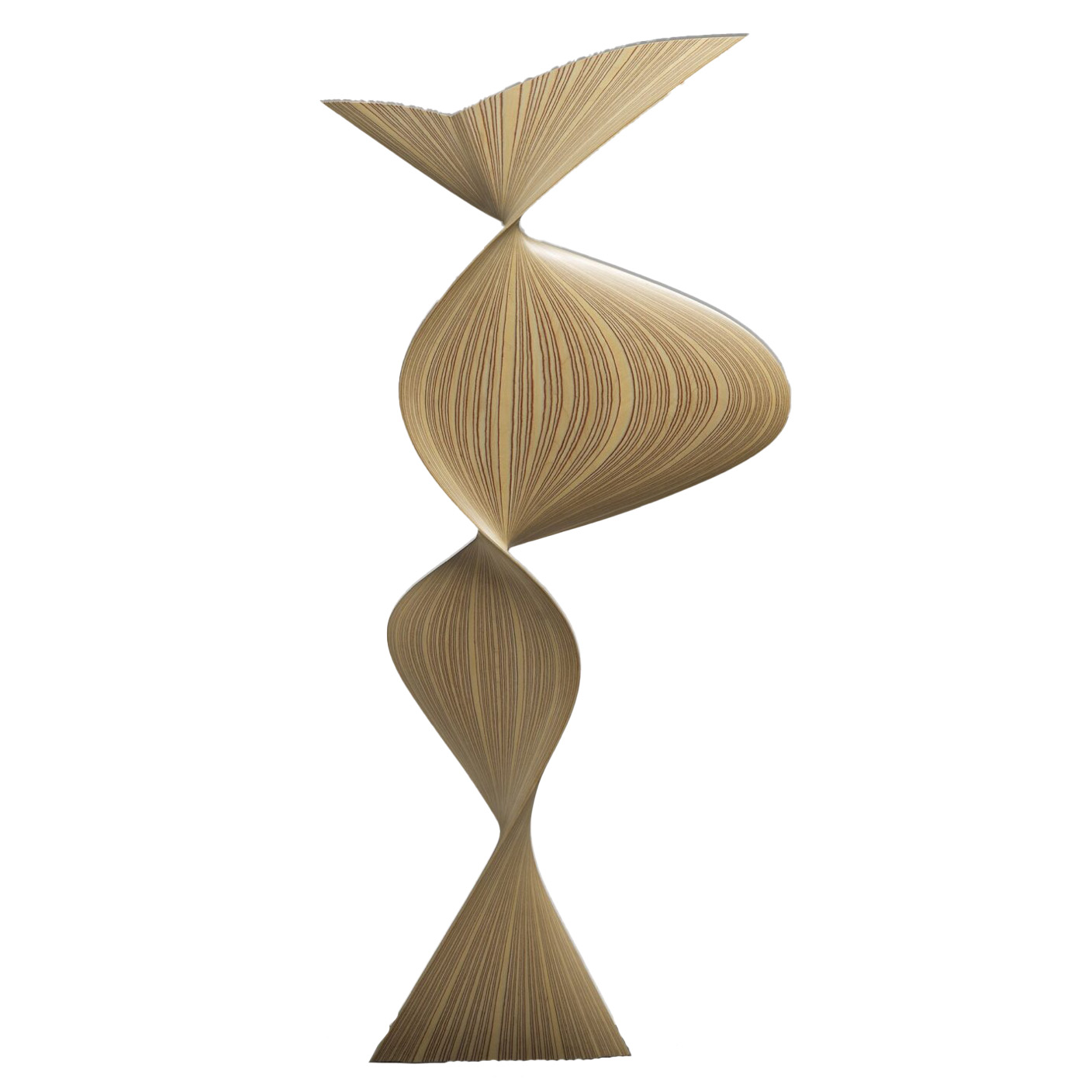
A work without title, with which Tapio Wirkkala pushed the flexible ‘aircraft plywood’ to its limits.
A sculpture like melting ice
The ‘Ultima Thule’ is Wirkkala’s most celebrated design. In this masterpiece, the artist visualized how nature erodes and constantly changes the landscape. The organic movement is clearly recognizable and is reminiscent of a three-dimensional version of thawing ice, with air bubbles trapped inside. This is also called air ice. The middle part of the wall consists of an unbroken sheet of the very flexible ‘aircraft plywood’, in this case consisting of 100 thin layers of birch wood.
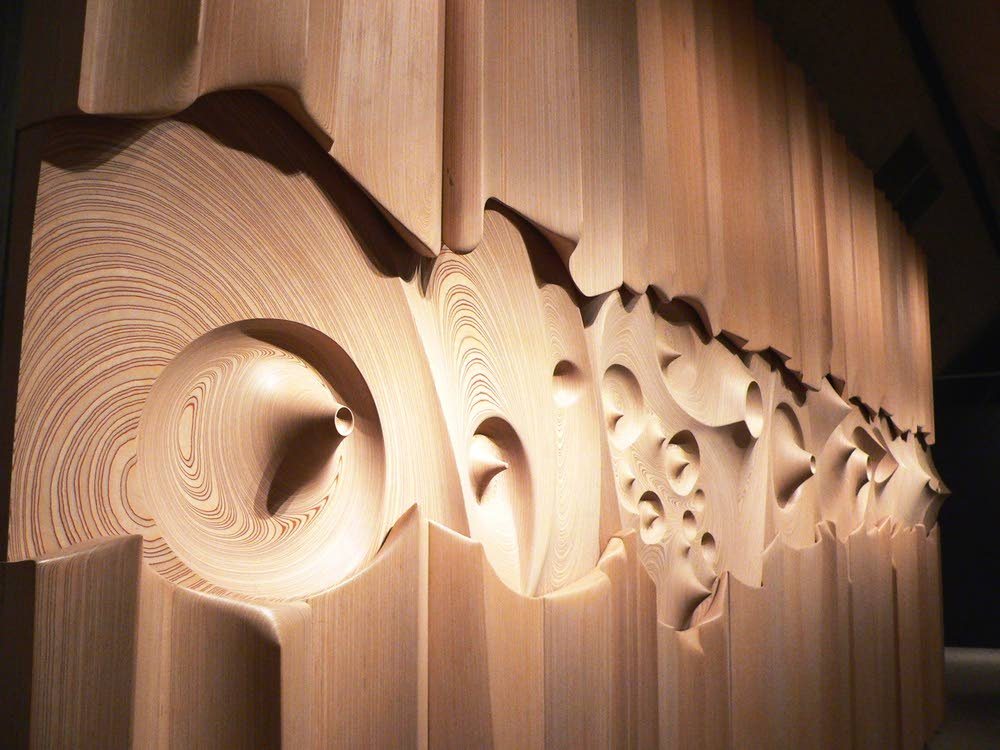
Tapio Wirkkala worked out the rhythm of plywood in a 9-meter-long wall.
I find it fascinating how a ‘factory-made’ product like plywood, after being processed by Wirkkala, begins to resemble the annual rings of a ‘natural’ tree. Even two surfaces glued together still look like two tree trunks placed next to each other.
The enormous wall was first exhibited at the international Expo 67 in Montreal, Canada in the Scandinavian pavilion. Of course, in the year 1967.

The bottom of a bowl signed by Tapio Wirkkala: just like a tree leaf.
Confusingly, Wirkkala also called his works in glass ‘Ultima Thule’. His tableware under this name is still for sale, produced by the company Iittala. His wooden bowls and trays regularly appear at auctions.
‘Poet in wood’
The wooden Ultima Thule is going on a world tour and will be on display in Japan from 2025 to 2026, along with 300 other works by the Finn. Until then, the work can be found at EMMA, the Espoo Museum of Modern Art, where his wife Rut Bryk has placed it.
Dutch woodworkers rarely choose to work in plywood or multiplex. I actually only know one, Gerhard Lentink. In his torsos of naked voluptuous women too, the line play of the glued sheets adds something to the overall image. But Lentink never goes as far as Wirkkala, who took the factory-made ‘annual rings’ precisely as the starting point for his work. Wirkkala was therefore also called ‘poet in wood and glass’.
Jan Bom