The Master of Hakendover hid Peter under rocks, which seem about to collapse. All lines in this wooden sculpture focus on the mourning face and folded hands of the apostle, who betrayed Jesus three times.
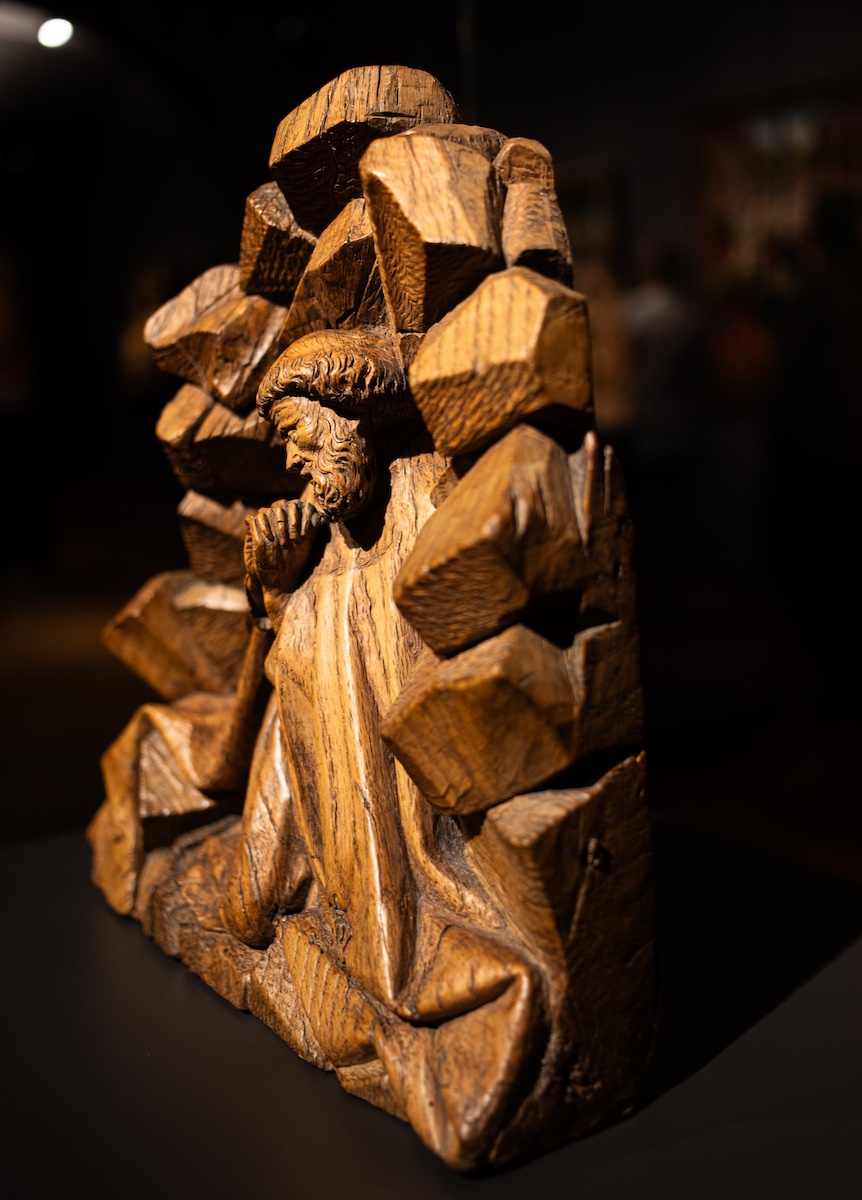
The Master of Hakendover hid Peter under rocks.
Peter squeezes his eyes tightly shut. He can no longer face the world. He has deep remorse for having betrayed Jesus three times, even before the rooster had crowed twice. Jesus had already predicted it. One of his 12 disciples would deny knowing him.
The sculpture is simultaneously dramatic and very sleekly executed, with the rocks as abstract elements. It seems as if ‘Peter shows remorse’ was not carved around 1425, but only very recently, so modern does the composition look.
The sculpture opens the Rijksmuseum
The fascinating sculpture more or less opens room 0.1 of the Rijksmuseum in Amsterdam, with medieval art. Another great like Adriaen van Wesel (circa 1417 – shortly after 1490) is also richly represented in this first room, including with a stunning sculpture of a medieval kiss. And not to forget: in those first rooms there are also two prayer nuts, from the workshop of Adam Dirksz. The ‘miniature wonders’ behind a glass display case constantly attract visitors.
The Master of Hakendover was (probably) an anonymous sculptor from the early 15th century, active in Brabantine Flanders – not far from Brussels. His name is derived from a retable (altarpiece) in the Saint Salvator Church of Hakendover. His work is characterized by a combination of international Gothic and an increasing naturalism. This made him an influential figure in the development of late medieval sculpture in the Low Countries.
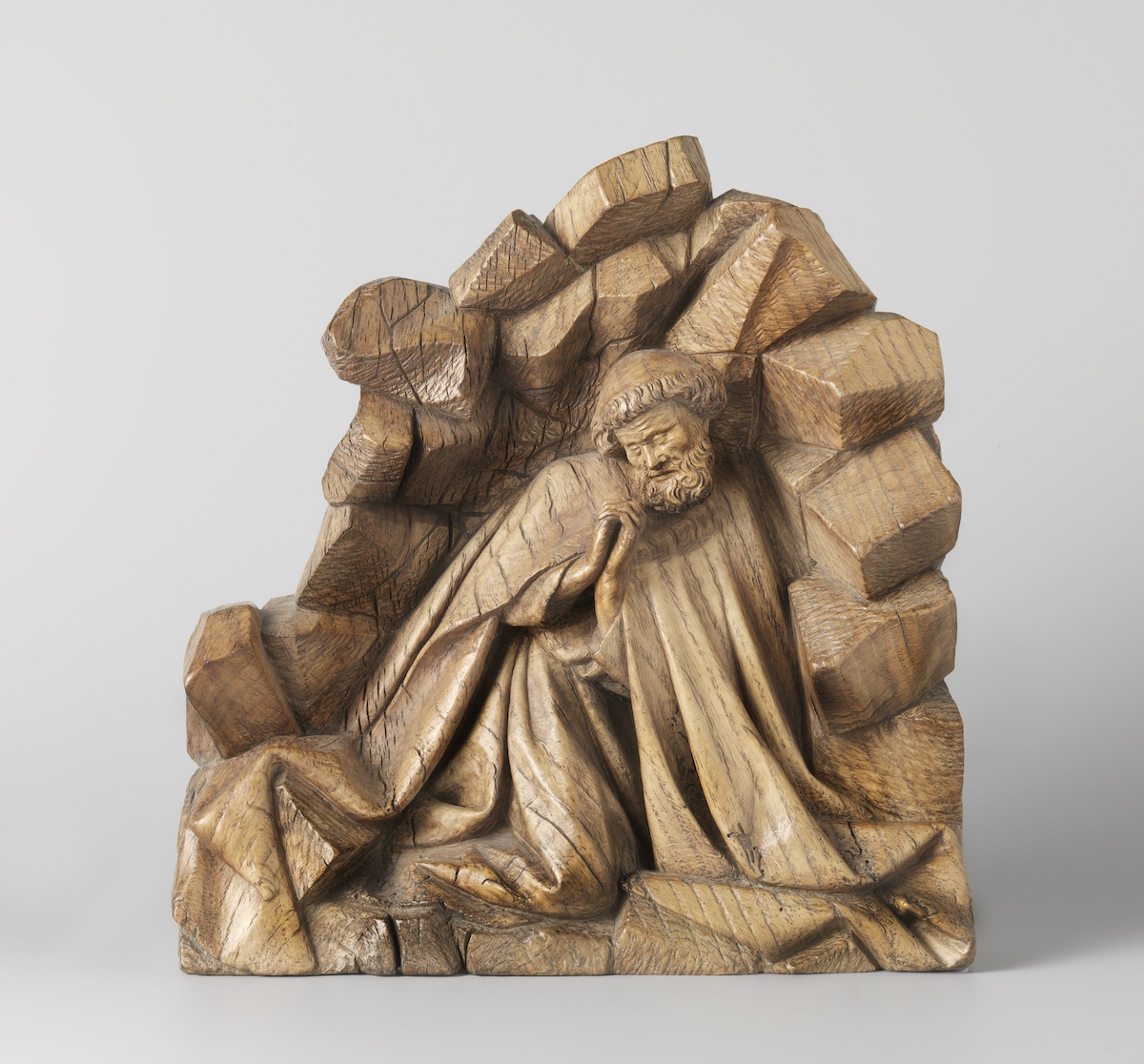
The Master of Hakendover suggests that Peter will be buried by rocks.
‘Peter shows remorse’ is carved from oak wood. This wood had a strong preference from the workshops for centuries, who mostly had the Catholic Church as their main client.
The apostle Peter is depicted kneeling, with folded hands, head bowed, full of shame. Beautiful how the folds of his robe lie draped over the rocks, as if he is half buried under the tottering rock.
The Master of Hakendover did not choose this symbolism for nothing. Jesus had earlier given Peter a nickname: ‘Rock’. After the ‘Rock Man’ was filled by the Holy Spirit at Pentecost, all his old fears had disappeared and he announced in a fiery speech what Jesus meant. He then converted many other people to Christianity.
Personal devotion
This work therefore illustrates well the artist’s emphasis on personal devotion and the inner experience of faith. That theme is hardly a source of inspiration for the artists of this time anymore. And the artisanal skill in wood carving of the medievals is given to only a few artists today.
The Master of Hakendover painted the sculpture. In those days it was called polychromy, which stands for the use of multicolored pigments, often combined with gold leaf. The sculpture in the Rijksmuseum has been ‘cleaned’ and shows not even a single trace of the original painting anymore. Also because of this the sculpture seems to have been carved only yesterday, so beautifully smooth and freshly sanded the oak wood looks. The workshop delivered with ‘The remorse of Peter’ a masterpiece of 34.6 centimeters height and 33.5 centimeters width.
Jan Bom, June 13, 2025