Wild flutes, made by Anna Hakvoort, like those of Native Americans. Hakvoort carves them from beautiful branches she finds in the forest. The flutes sound beautiful and comforting.
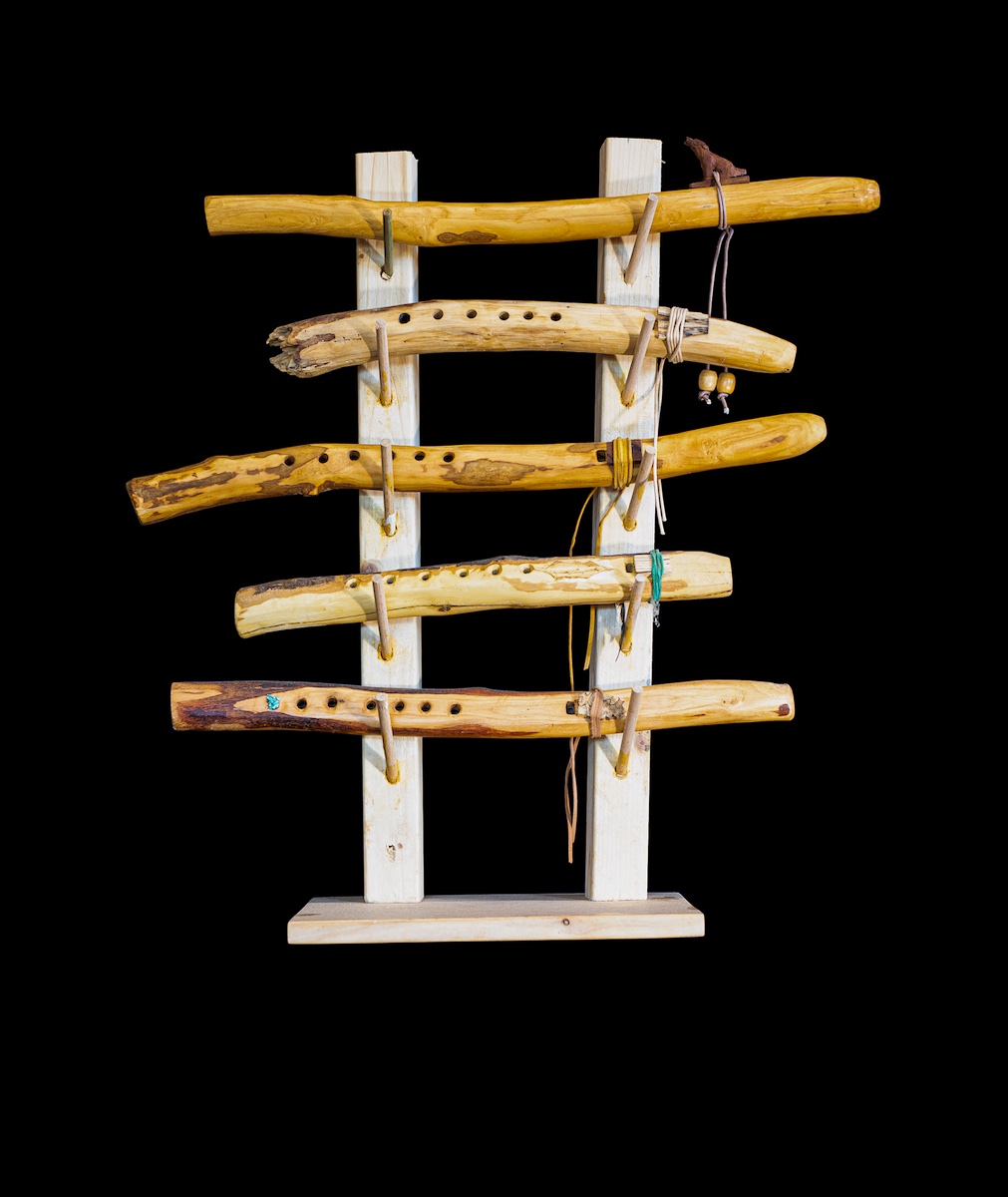
Wild flutes, made by Anna Hakvoort, presented in a rack.
Anna Hakvoort (1960) likes to wander through forests or along the banks of the great Dutch rivers. This is how she began as an artist, carving driftwood with a pocketknife. First removing the soft and rotten parts, following the shape of the natural wood. Intuitively.
What is hidden inside the wood? This question has remained central to her way of working. I would call it Form follows Nature, fitting with the thinking behind Dendroism. Or, even better: Form follows Forest.
Long ago, she took lessons from Jan van Harskamp in Zetten. She now also organises courses and workshops herself in an old boathouse near Nijmegen.
Those who want to can also learn how to carve flutes from her. She hollows out branches and drills holes in them. How does she do it? It sounds simple. “I first saw a branch in half, hollow it out and then glue the two halves back together invisibly. Then I drill the holes for the notes.”
Pure, deep and resonant
These musical instruments look wild. Hakvoort herself calls them ‘Native American Flutes’. She is not the only one. “I am a member of a Facebook group of people who all make flutes based on Native American examples.” The group counts more than 6000 members worldwide.

Anna Hakvoort is happy to demonstrate her flutes.
And they really can be used to make music. Anna is happy to demonstrate this. They sound remarkably pure, deep and resonant. They are especially suited to soft, gliding melodies. The sound is nothing like that of a recorder.
I can imagine that such flutes could even be comforting to people who are confused or distressed. Hakvoort has a background in care work and still supports people with severe psychological problems.
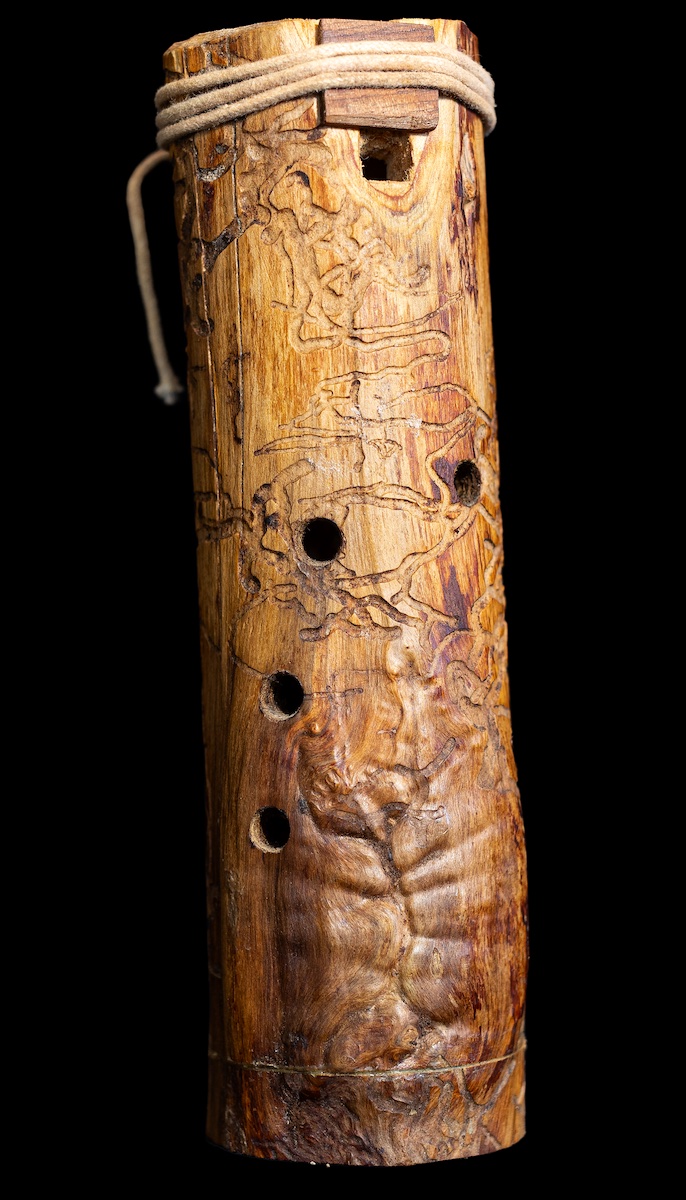
A very special flute with a labyrinth of tunnels under the bark.
She made one of her most remarkable flutes from a fairly thick branch. Under the bark, the larva of a jewel beetle (Agrilus viridis) had possibly carved a labyrinth of tunnels. It looks like an ecological maze. This species occurs in the Netherlands on beech, birch and willow. Anna left this beautiful network completely intact.
You could almost forget that in Canada and the northern United States, the larvae of the emerald ash borer are a serious pest. Their zigzagging tunnels beneath the bark can severely damage forests.
Jan Bom, 15 september 2026