In Dreams is a sculpture inspired by a painting by Gustav Klimt: Wasserschlangen II. This late work by Klimt is ‘Not on View’. It has disappeared into a heavy safe as an art investment, owned by the Russian oligarch Dmitry Rybolovlev.
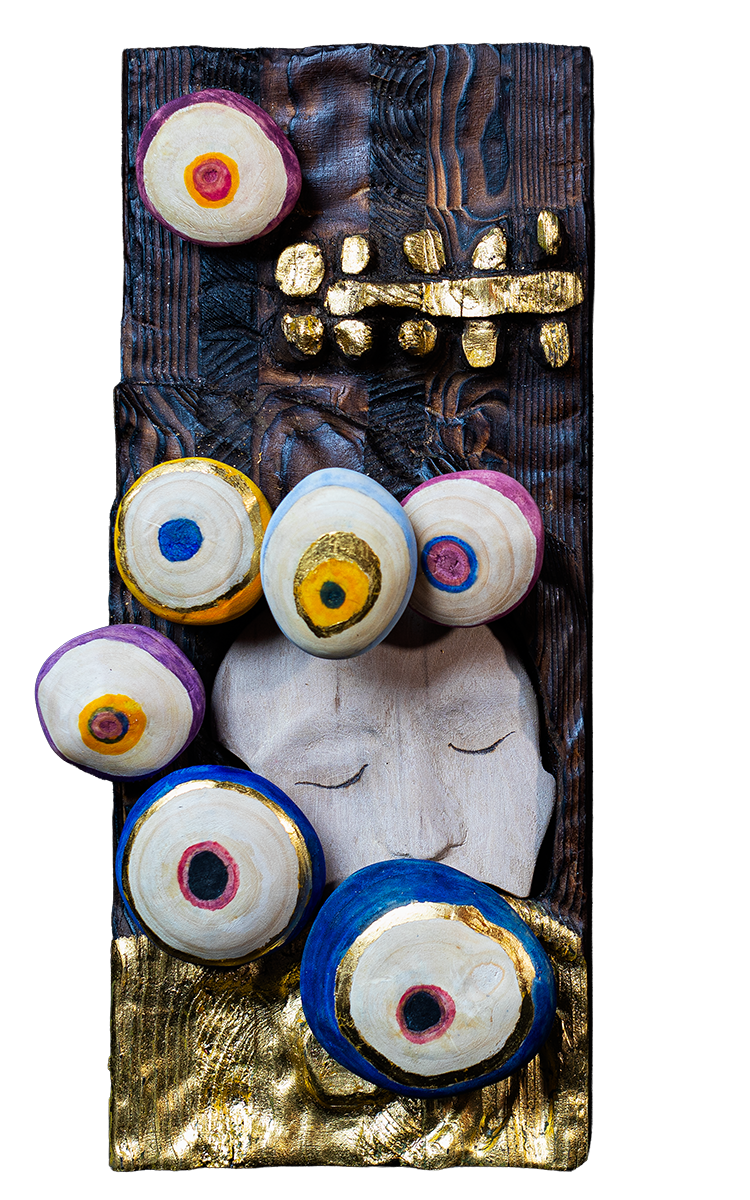
In Dreams, my wooden version of Klimt’s masterpiece.
The painting plays a major role in the documentary The Oligarch and the Art Dealer. The French art dealer Yves Bouvier sold it to the Russian for a much higher price than he had paid for it himself. Bouvier had bought it privately through Sotheby’s for around $126 million and then sold it to Rybolovlev for $183 million. This was despite having agreed to charge no more than 5 percent in commission on transactions.
The fraud only came to light years later, following an article in the British newspaper The Guardian. A long legal battle between the Frenchman and the Russian followed. Bouvier eventually won. In the film, the Frenchman says several times: “This painting doesn’t really have a price.” At the same time, he added an enormous markup. According to the documentary makers, Wasserschlangen II is now worth considerably more than the amount the Russian paid for it.
Only photographs remain
What bothers me most is the fact that Klimt’s late masterpiece can no longer be seen by the public. There are good digital reproductions available online, but the original belongs in a museum, accessible to everyone.
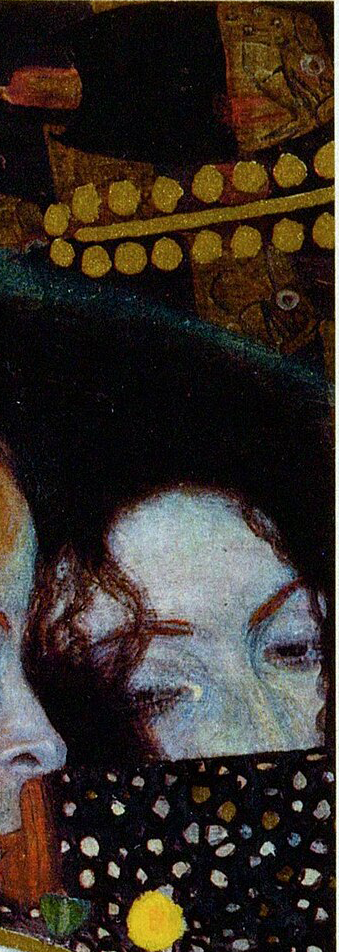
Detail of the upper right corner of Klimt’s Wasserschlangen II.
Out of that frustration, I recreated a fragment of the painting in wood: the dark upper right corner. It is certainly not an exact copy, but rather an attempt to capture the Klimt feeling: dreamlike, with lots of colourful and golden ornaments. It is more of a reconstruction.
The choice of wood species gives my version, In Dreams, characteristics of Dendroism, in which the wood itself becomes part of the story.
In Dreams in wood
The base is spruce from sustainable timber construction, made from glued layers of wood. After carving the rough forms, I burned the surface layer, turning the light ‘skin’ dark. The end grain is rough, while the long grain is very smooth.
The face is made from the pale sapwood of a piece of American walnut. In Klimt’s painting too, this face is more of a mask than a portrait.
The coloured discs with their growth rings are cut from branches of the tree of heaven (Ailanthus altissima), a non-native and undesirable species in Europe. This Asian species can displace other trees, and its bark is toxic to some plants and insects. Trade in this species has been prohibited since 2019.
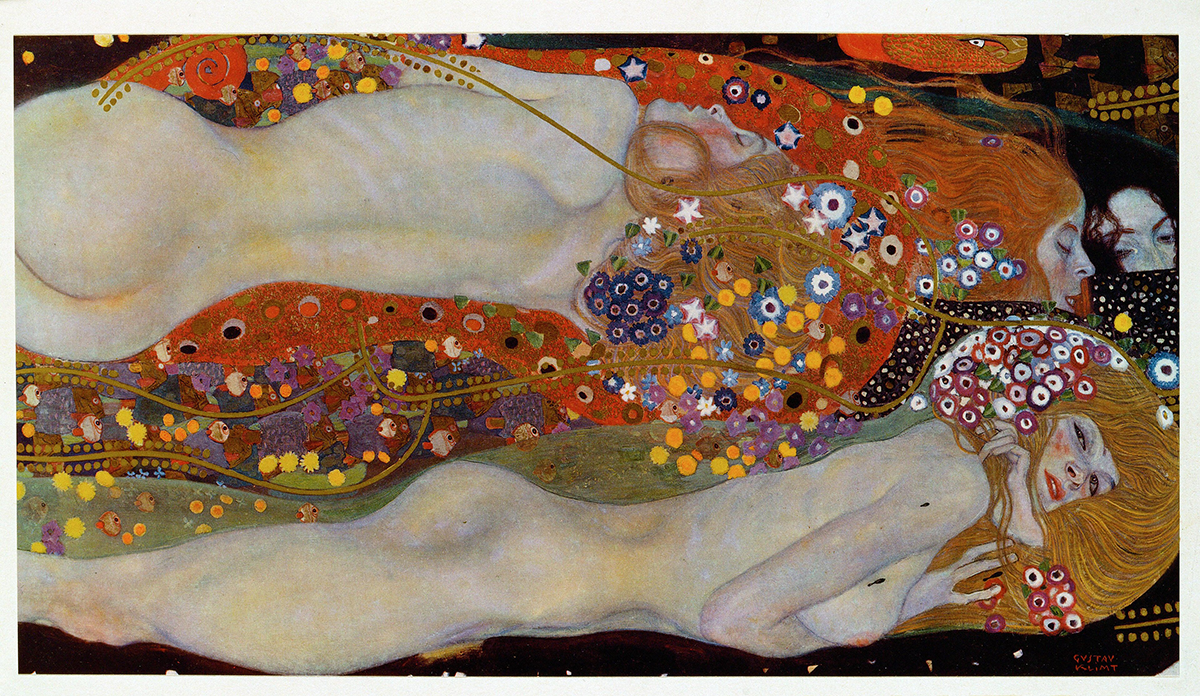
Klimt’s complete painting, with four water nymphs
Klimt’s painting itself measures 80 × 145 cm and shows four female figures lying horizontally, one above and beside the other. Their bodies partially overlap, making it difficult to tell where one body ends and another begins.
This is no coincidence. Klimt deliberately used this interweaving of the figures. The two women in the foreground are the most clearly visible. The blonde woman lies almost frontally and looks directly at the viewer. Behind her lies a red-haired woman with her back towards us. Behind them are two more women, of whom only parts of their faces and bodies can be seen.
Female sexuality
And then there are the long, snake-like golden forms. They are not simply decorative. They connect the women with the imagined underwater world. The painting therefore suggests that these are not ordinary nude figures, but water creatures or nymphs.
From 1904 onwards, Klimt made a series of drawings for Wasserschlangen II in which he explicitly explored female sexuality. It is a fantasy world in which eroticism, the body and mythology come together.
Klimt also combined two completely different ways of painting. The women’s bodies are soft and almost transparent, with skin tones, shadows and subtle modelling. In contrast, there is the flat, decorative world around them: patterns, scale-like forms, hair, snakes and ornament.
Wood accentuates the decoration
It is remarkable that a three-dimensional wooden interpretation of this painting makes this contrast even stronger.
I am still wondering whether to leave it at this one experiment, or continue and recreate Klimt’s entire painting in wood. According to my wife, it would look beautiful above the sofa. For now, I will first see what other people think.
Jan Bom, 28 September 2026