Le Corbusier assembled a woman like a building. The world-famous French architect constructed the sculpture from geometric wooden forms, just as he designed buildings from clear volumes and proportions.
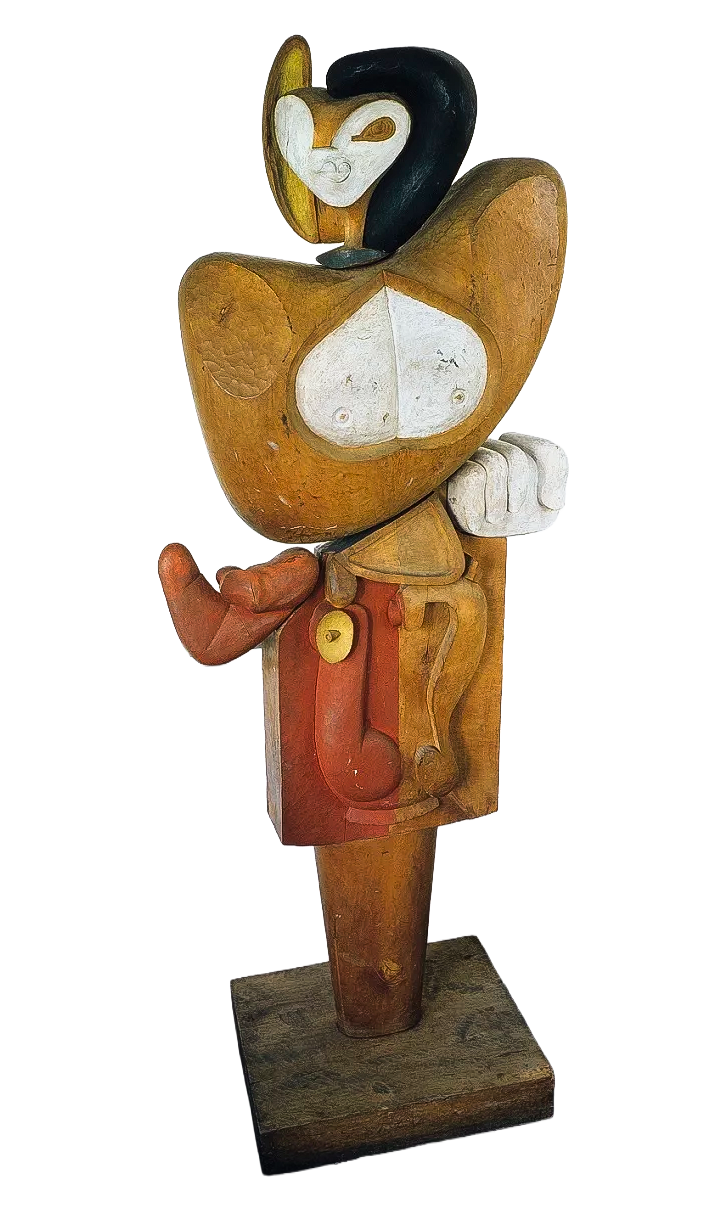
Le Corbusier assembled a woman like a building, using 1.83 metres as the ‘human measure’.
Le Corbusier (1887–1965) was one of the great innovators of twentieth-century architecture. Less well known is the fact that, from the 1940s onwards, this Swiss-born architect also became deeply involved in sculpture.
La Femme, from 1953, is the strongest example of this. The almost two-metre-high sculpture is made of polychrome (painted) wood. Le Corbusier created the sculpture together with the Breton furniture maker and woodworker Joseph Savina.
Like a small building
Le Corbusier wanted to create a sculpture that was not modelled after a human figure, but assembled according to his ideas about forms. Savina translated his drawings and instructions into wood. Le Corbusier then applied the colour himself.
The sculpture almost looks like a small building. Its components are recognisable, yet strongly simplified. Form, proportion, rhythm and colour are more important than a lifelike representation of the human body.
The height of 1.83 metres is also striking. This measurement was not chosen at random. The large version of La Femme was made exactly as tall as Le Corbusier’s idea of the ideal human height. His ‘Modulor Man’ symbolises the system of proportions he developed to base architecture on the human scale. The woman thus literally becomes an architectural measure, although in the case of La Femme she has been given the height of a man.
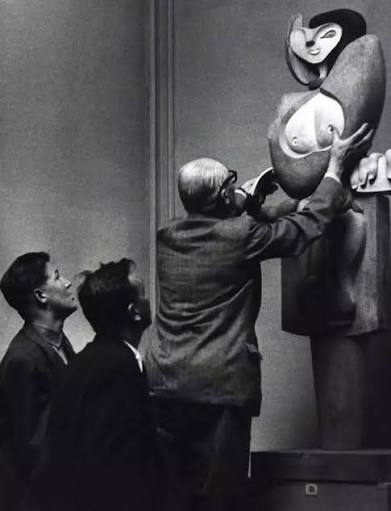
Le Corbusier installed La Femme in 1953.
Le Corbusier was one of the most important figures of Modernism, the movement that broke with historical architectural styles and sought a new architecture for modern society. His early architecture was strongly influenced by Purism, the artistic theory he helped develop. Geometric forms, clear proportions and a limited palette of powerful colours were central to it.
Architecture of the human body
Later, his architecture became more expressive and sculptural. This can also be seen in his sculpture. La Femme is therefore not separate from his architecture. It is actually a three-dimensional continuation of it. For Le Corbusier, the boundaries between painting, sculpture and architecture became increasingly blurred. The Fondation Le Corbusier therefore speaks of a ‘synthesis of architecture, painting and sculpture’.
La Femme shows that Le Corbusier did not use wood to create a classical wooden female figure. He used it to express his ideas about form, proportion, colour and space in three dimensions. The sculpture is therefore a kind of architecture in human form.
Le Corbusier paid no attention at all to the natural properties of the wood. La Femme is therefore almost the opposite of Dendroism: it is not the wood that determines the form, but the artist who determines the form of the wood.
Jan Bom, 12 September 2026