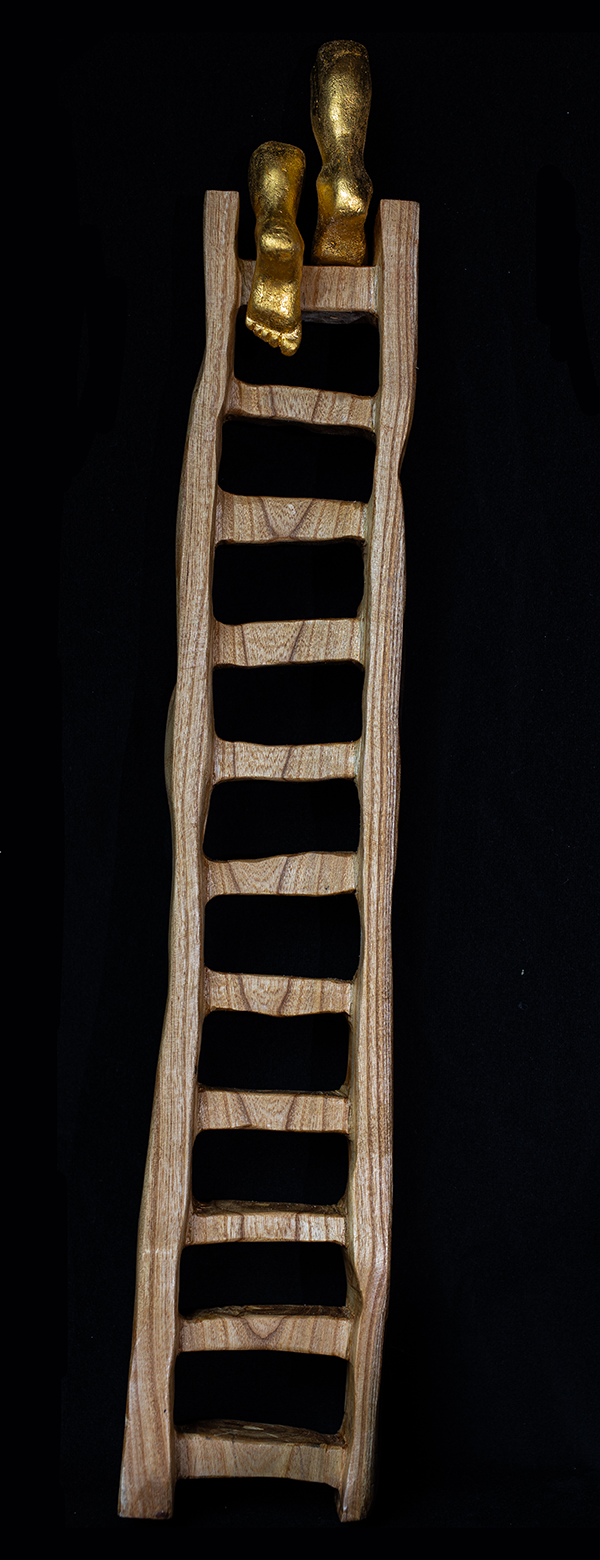
Rise, climbing toward an ecological society, is a sculpture full of symbolism. What you see are two feet reaching the top of a ladder. What does it mean? That may be something different for everyone.
Rise: Climbing Toward an Ecological Society
Those who read the Bible know the early Biblical command in Genesis. Humanity was appointed by God to “cultivate and keep” the earth. From this idea of stewardship, people are meant to care for nature and preserve it. In other words: not exploit it or exhaust it.
But unfortunately, humanity has failed badly in this role as the “crown of creation.” Animal species are disappearing. Natural resources are being depleted. We are even poisoning the soil from which we eat.
Ladder of Life
Those familiar with the ancient Greek philosophers know that Aristotle developed a “ladder of life.” He too created a hierarchy. Lifeless “things,” such as minerals, occupied the bottom rung. Above them came plants. Above the plants came animals. And finally, at the very top, stood humans — along with their gods.
Centuries later, Descartes reinforced this way of thinking by claiming that animals were merely “automata.” According to the Enlightenment philosopher, animals possessed neither intelligence, language, nor pain. Even Darwin was initially hesitant to reveal that humans and apes are genetically closely related.
Human superiority
In the recently published book De ecologische samenleving, edited by Kees Klomp, I read that this sense of human superiority still shapes much of our thinking and behavior. “It is a persistent worldview,” writes Anne van Leeuwen in this substantial volume.
I quote her: “The literal translation of ‘Anthropocene’ is ‘the age of man.’ The impact of Western humanity has now become so great that we ourselves have become a geological force. (…) But it is a misleading term. Because if this era teaches us one thing, it is that ‘nature’ is no passive background — and in fact never was.”
Across many chapters and from different perspectives — including economics, landscape development, agriculture, law, philosophy, and health — Klomp and his contributors argue that humanity should no longer place itself at the top of that ladder. If we want to keep this earth habitable for future generations, we must begin to see ourselves as an equal part of nature. And behave accordingly.
Systemic change needed
I was reading this book while carving the sculpture Rise. “My ladder” gradually became, for me, a critique of this old way of thinking. A radical systemic change will be necessary to replace this centuries-old worldview.
I cut the ladder itself from a catalpa trunk (“trumpet tree”) using a scroll saw. I kept the form rough and as natural as possible. In my imagination, the ladder that the Biblical Jacob saw in his dream must have been just as primitive — yet sturdy enough to allow all those angels to ascend and descend between heaven and earth.
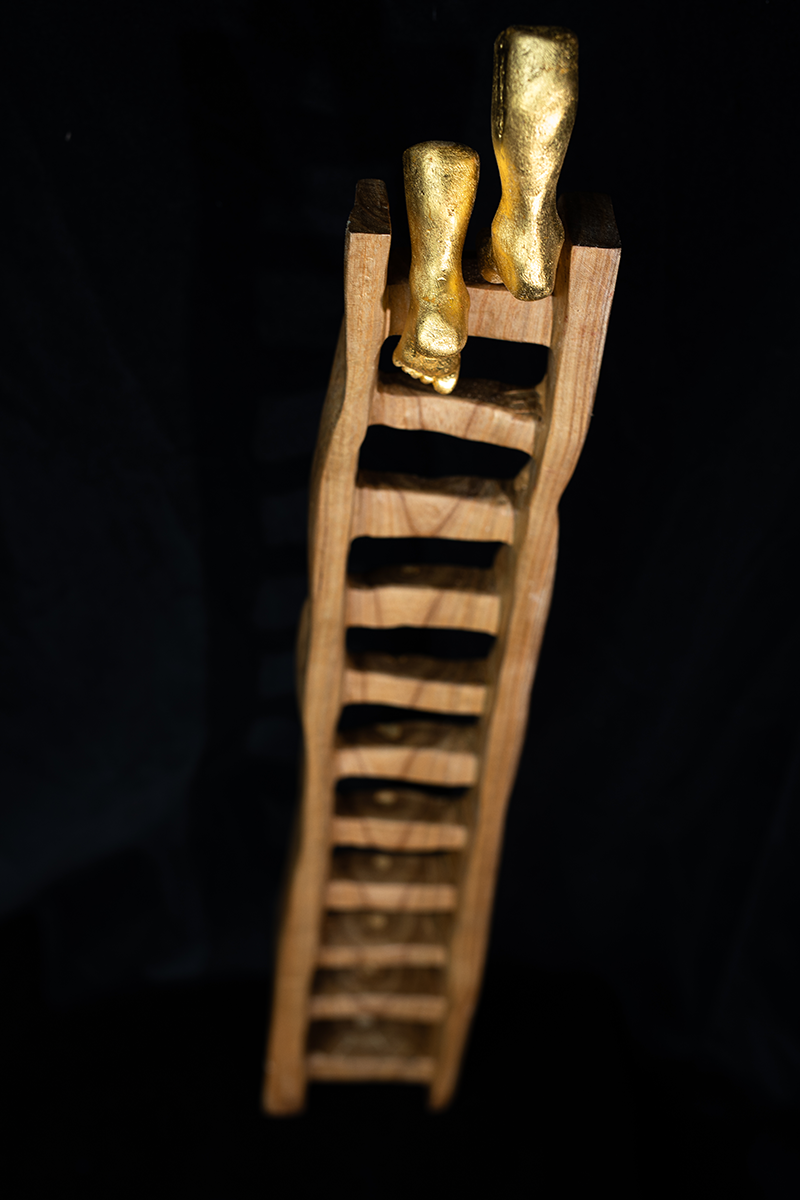
Rung, like the round dots on a domino stone.
In every rung, the pale heartwood of the trunk remains visible, like the round dots on a domino stone. A subtle reference to Dendroism, in which the tree itself becomes a storyteller of nature. To further emphasize the grain and markings of this beautiful wood, I finished it with Osmo hardwax oil.
The two feet were carved from linden wood and gilded with 24-carat gold leaf.
From Jacobs’ ladder to ecology
The sculpture gradually changed meaning for me. At first, I wanted to create a Jacob’s Ladder — the dream that connected heaven and earth. Very rough and primitive, because in the time of Genesis they did not yet have sleek, polished staircases. Then came the feet of an angel, which I had imagined at the bottom of the ladder, as if the imaginary body had already ascended. But that idea did not “work” as a sculpture. The back of a foot is boring to look at. Nothing happens there.
Then, while playing with a wax model of a small foot, I discovered that placing a foot at the top of the ladder did work. I found it much more intriguing. The story shifted because of it, with those human feet standing so eerily at the top of the ladder. In my mind, I exchanged Jacob’s Ladder for another Biblical passage, in which God commands humanity to be stewards of nature and to stand above all other animals and living things.
The fact that the sculpture creates a sense of instability is therefore exactly right. I believe that the centuries-old interpretation of these Biblical texts should not be that humanity must stand ABOVE all other life, but rather AMONG nature — an ecological perspective. The sense of “danger” now expressed by those feet at the top of the ladder is precisely what the sculpture is meant to convey. Humanity standing up there on that ladder, above all other life, has become a danger, even to itself.
In that way, Rise became my ascent toward an ecological society.
Jan Bom, May 14, 2026.