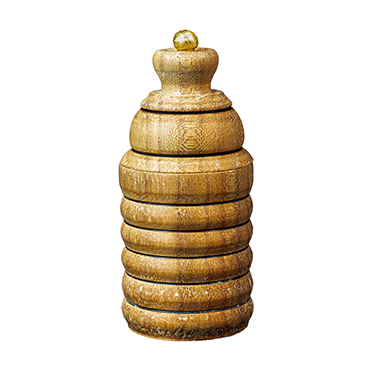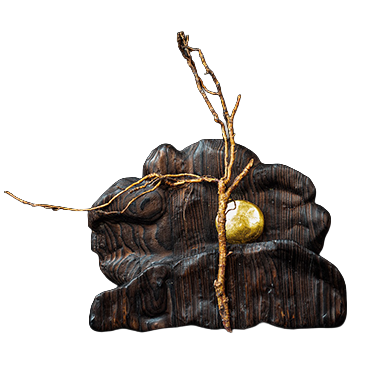
Titus Kaphar carves his family as saints, their heads surrounded by golden halos. In doing so, he honors the people who sustain his personal life.
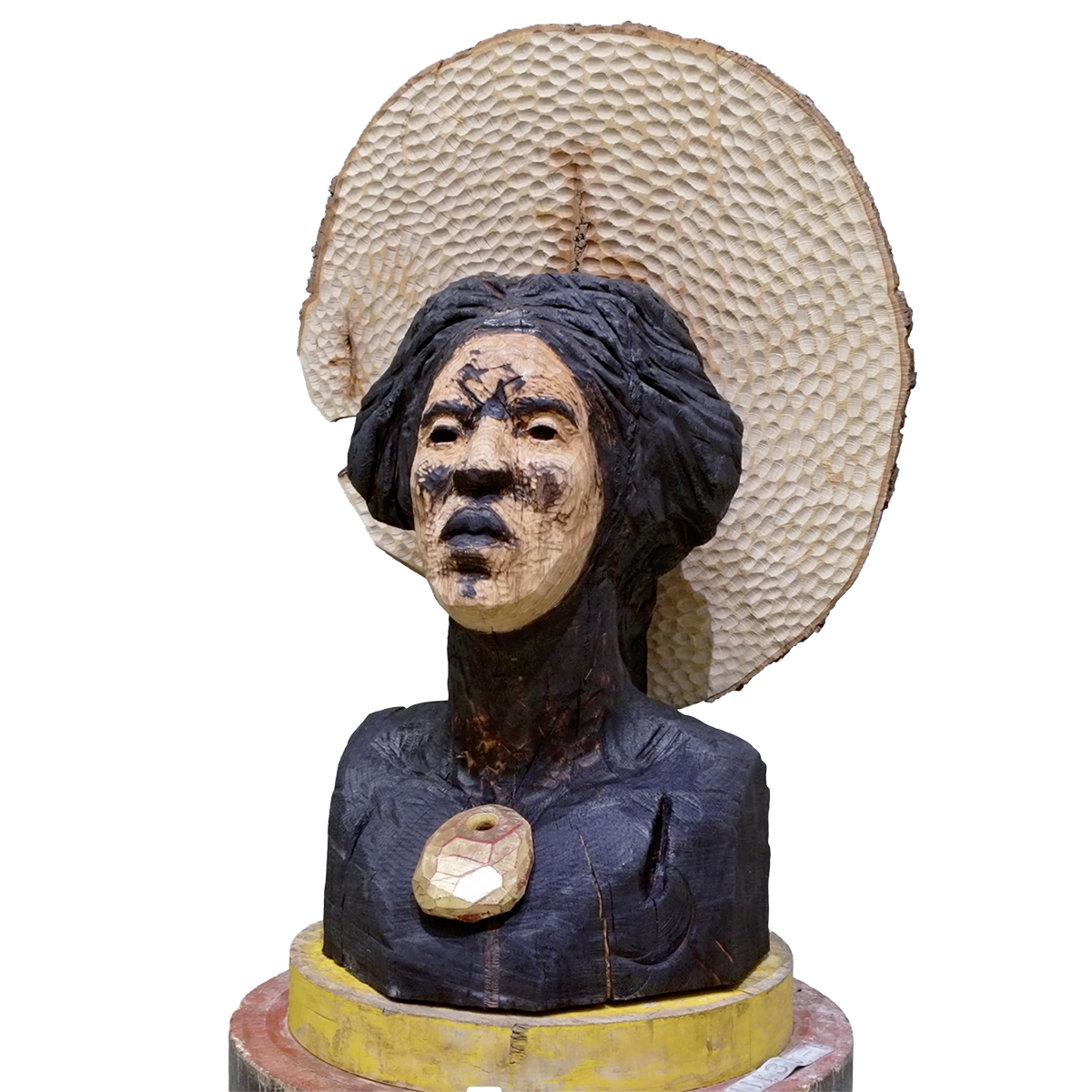
Titus Kaphar carves his family as saints, as seen in this sculpture, While You Rest from 2025.
The American artist Titus Kaphar explores, through painting, sculpture, and film, how history is written — and especially who is allowed to remain visible within it. His work revolves around forgotten lives and erased stories. How has art, for centuries, reinforced existing power structures? Who was allowed to be painted? And who was not?
Yet Kaphar’s oeuvre is not defined solely by politics or history. In his most recent wooden sculptures, a far more personal dimension emerges: he portrays family members and friends as contemporary saints.
Painting over existing works
Kaphar was born in 1976 in Kalamazoo, Michigan. He grew up in a Black community where faith, solidarity, and personal struggle were deeply intertwined. He studied at San José State University and later earned his MFA from Yale University.
International recognition came through paintings in which he literally disrupted classical Western art. He painted over existing works or even tore them apart, questioning who had disappeared from the historical image.
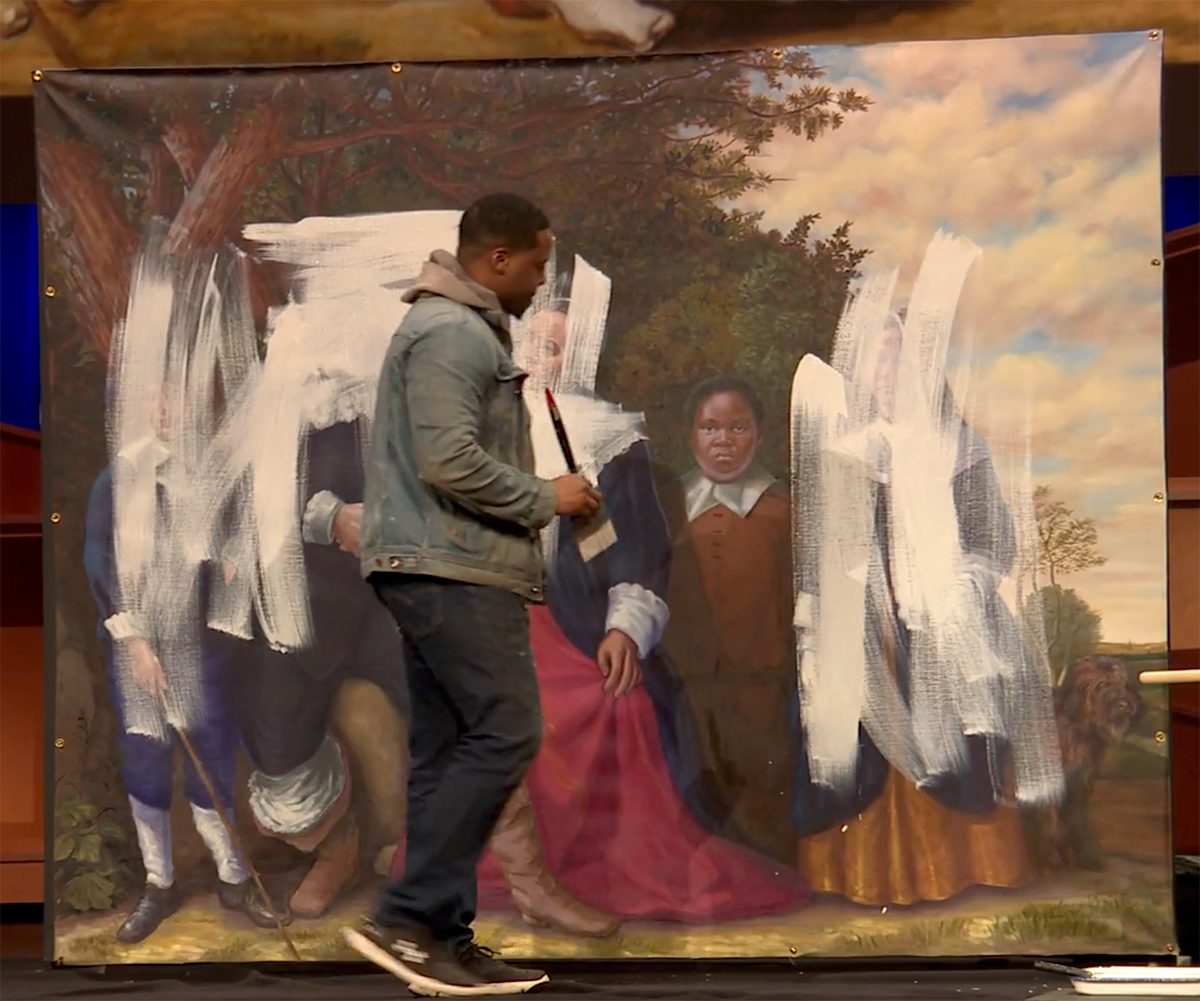
Titus Kaphar famously painted over a work by Frans Hals, leaving only the Black servant of the wealthy family visible.
During a celebrated TED Talk in 2017, he painted over a replica of a painting by the Dutch master Frans Hals. The seventeenth-century painting depicts a wealthy Dutch family posing in a landscape. During the presentation, Kaphar covered the faces of the white sitters with white paint. Only the young Black servant remained visible — portrayed by Hals as a bewildered status symbol. For wealthy merchants of that period, a Black servant functioned precisely as such a symbol of prestige.
Kaphar’s message was unmistakable: art history has placed certain people at the center while literally pushing others into the background.
The TED Talk, can be viewed here:TED Talk: Can Art Amend History?
Social erasure
His search for hidden histories has autobiographical roots. Kaphar grew up largely without a father. The discovery of prison photographs of men sharing his father’s name inspired his long-running series The Jerome Project. In these works, he partially submerged gilded portraits in tar. That black layer became a symbol of both social erasure and survival.
From that same personal background emerged the recent wooden sculptures. In 2026, they attracted considerable attention at exhibitions held by Gagosian in Paris and New York. In the exhibition The Fire This Time, Kaphar presented roughly carved wooden sculptures of friends and family members. He described them as “saints” — people who had carried and sustained him throughout his personal life.
Charred surfaces
But Kaphar did not carve traditional saints of the kind still found in churches and museums. Instead, he combined influences from Byzantine icons, Renaissance sculpture, and African American history with charred surfaces and industrial materials.
Some sculptures from this series appear to emerge only partially from the tree trunk, as though the human figure remains connected to the living material. Others bear gold leaf or halos that evoke the religious art of Florence, a city that profoundly impressed him. The charring of the wood gives the sculptures a dark, almost sacred skin, while simultaneously evoking fire, destruction, and rebirth.
Remarkably, Kaphar does not seek holiness in martyrs or ecclesiastical figures, but in ordinary people from his immediate surroundings. His mother, friends, and protectors receive the dignity that art history traditionally reserved for kings, popes, and biblical figures. In doing so, he shifts the idea of devotion from the heavenly to the human. Love, care, and loyalty become sanctified.
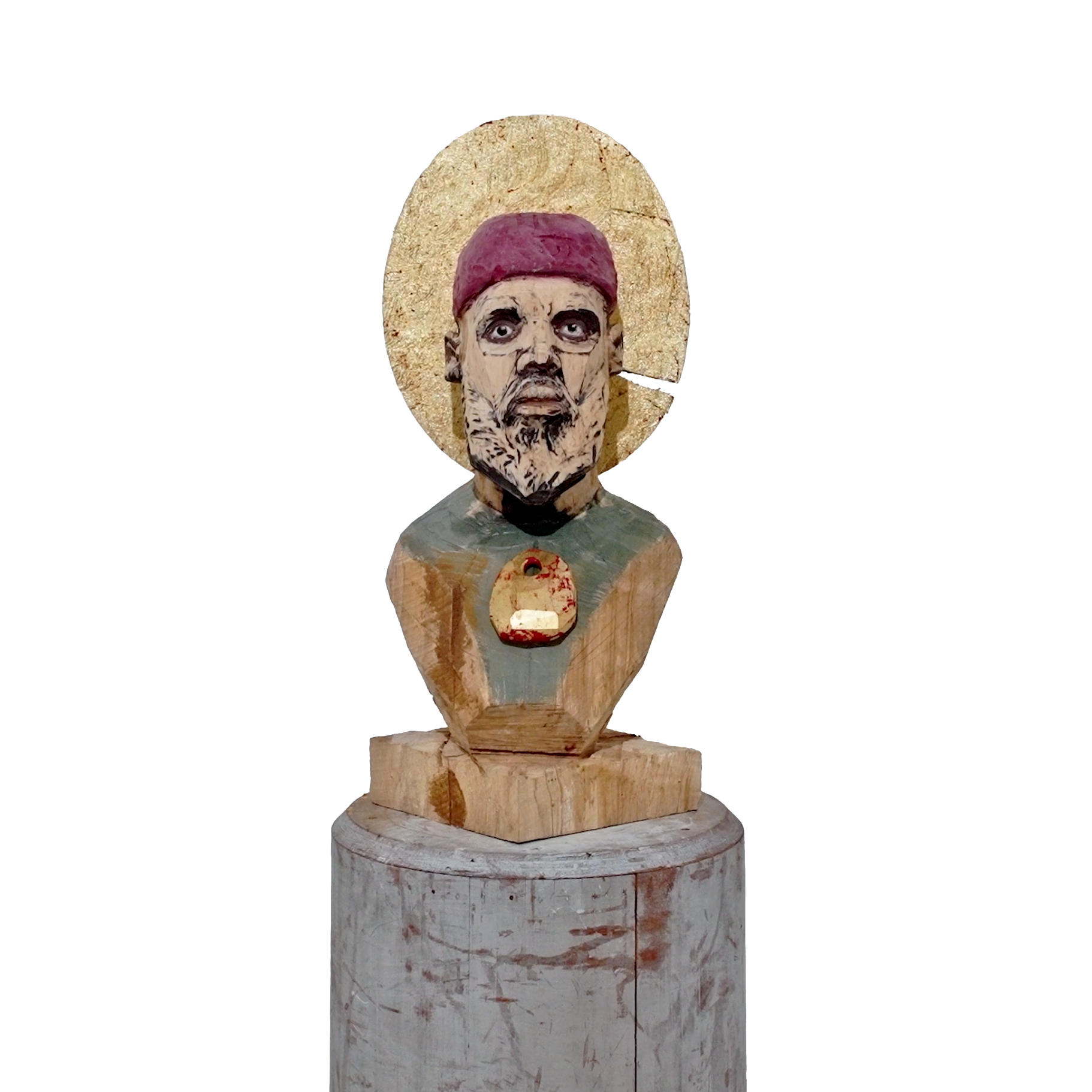
While You Wake is another sculpture from Kaphar’s wooden Sentinel series.
Kaphar’s wooden sculptures thus overturn a long tradition of religious woodcarving. Where medieval sculptures often evoked a distant divine world, Kaphar brings the sacred back into the human community. His figures resemble guardians of memory: vulnerable, charred black, yet dignified. Their backs remain straight despite histories of slavery and discrimination.
With these sculptures, Titus Kaphar has entered a new phase in his artistic career. His work is no longer solely about restoring erased histories, but about honoring the people who sustain his life. Through wood, fire, and gold, he makes visible what he believes is truly sacred: human connection.
Jan Bom, May 19, 2026
The sculptures shown are taken from a web movie by Gagosian and the TED Talk.