The Right Direction shows an arm with a hand pointing downward, toward the earth. Not aggressive, not accusatory, but determined.
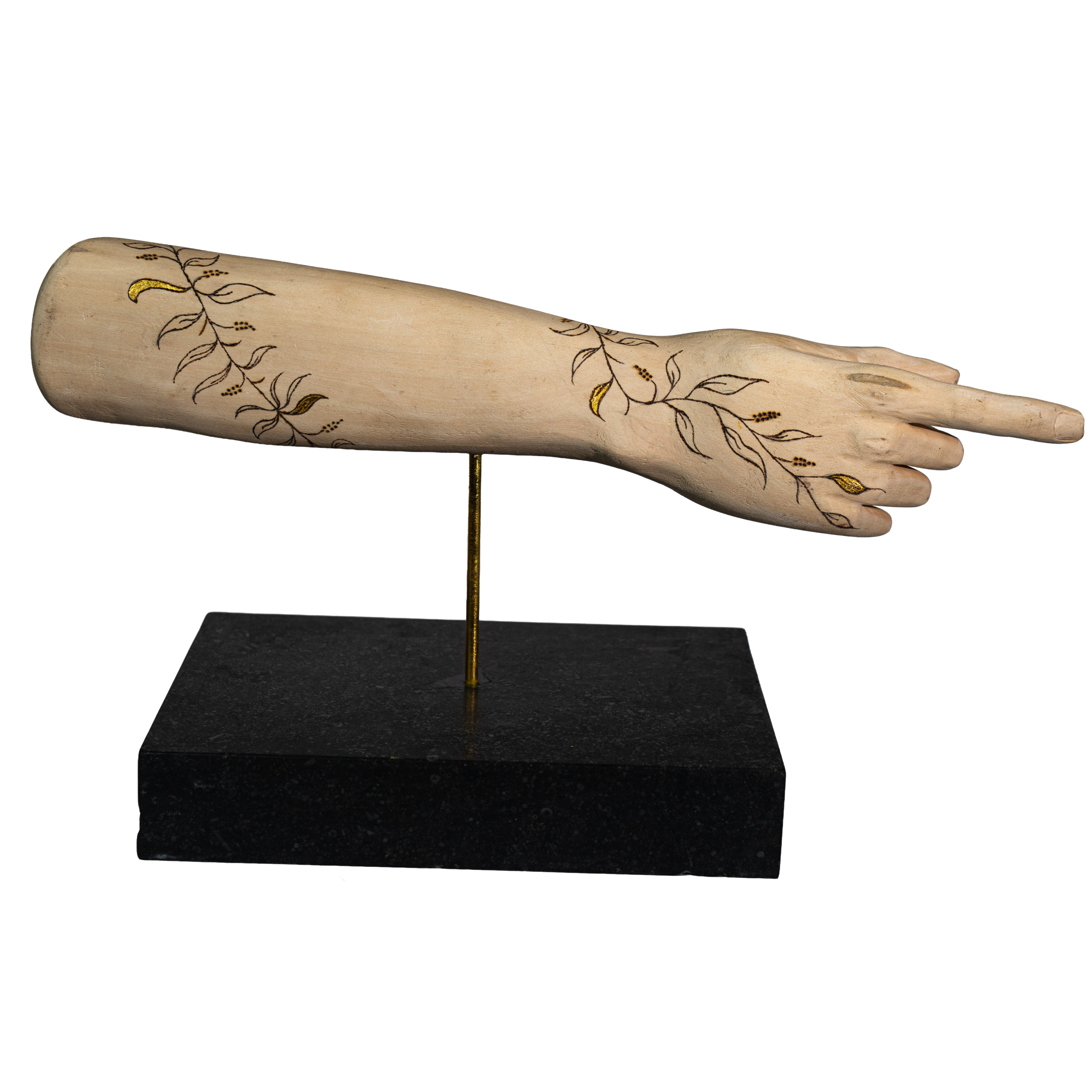
The Right Direction, pointing downward, toward the earth.
I borrowed the direction of the hand from the famous Hand of God in Michelangelo’s ceiling painting in the Sistine Chapel. But that is also where the comparison immediately ends. Where Michelangelo depicted the moment in which God gives life to Adam, my hand points more toward a direction. Not a starting point, but a path.
The arm itself is covered with a tattoo of a climbing plant slowly winding its way around the wood. Some of the leaves are rendered in gold. The tattoo does not appear as decoration, but as a sign of natural growth. As if the arm is not merely a body part, but a landscape in which nature and humanity merge together.
Believe in progress
I hope the sculpture raises questions. What is this hand, acting as a signpost, pointing toward? The origin of life? Or perhaps something we continuously overlook? In any case, the downward movement feels remarkable in a time when progress is usually imagined upward: building higher, living faster, producing and consuming more and more.
The Right Direction turns that belief in progress upside down. The right direction leads back to the ground. In this case, toward a pedestal of Belgian bluestone.
That idea is reinforced by the material of the sculpture itself. Wood always carries a history within it, a story of its own. That is what Dendroism is about. In this sculpture, that idea becomes almost symbolic. The wooden arm does not seem to be made of dead material, but of an organism that once grew and still possesses an inner movement. As if nature has reclaimed the arm, like an overgrown ruin.
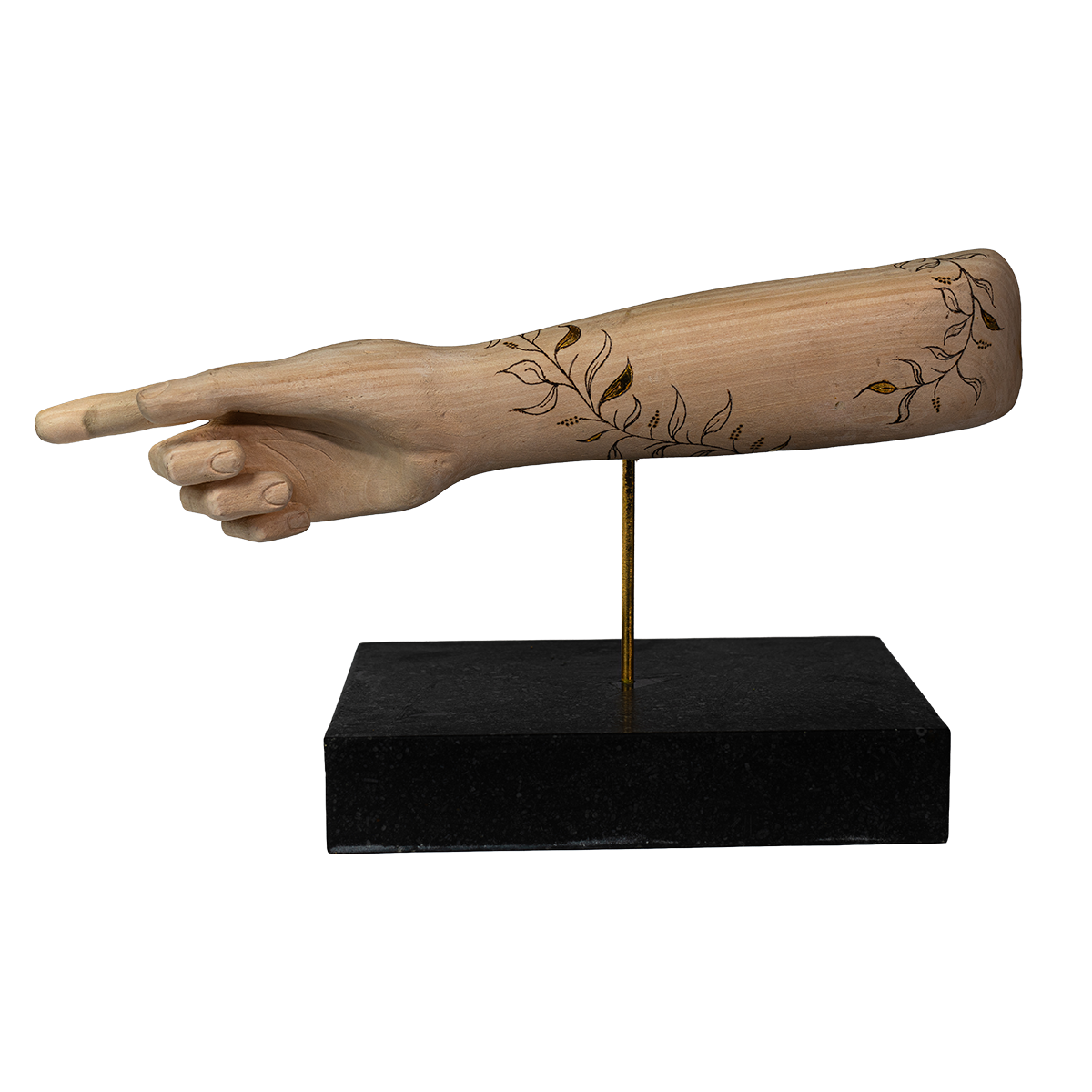
The Right Direction, with the hand seen from the inside.
Several golden leaves add a second layer to the work. Gold has traditionally been associated with holiness, eternity, and wealth. Medieval painters used gold leaf to make the divine visible. I do not seek the sacred outside the world, but within the living and the earthly.
An ecological sculpture
Precisely for that reason, the reference to Michelangelo gains meaning. The famous hand in the Sistine Chapel floats in an almost supernatural space. The Right Direction brings that symbolism back down to earth. The hand points not toward heaven, but downward, as if the sculpture wishes to say that spiritual meaning should not only be sought above us, but also beneath our feet.
I therefore see The Right Direction primarily as an ecological sculpture. At a time when the relationship between humanity and nature is under great pressure, this wooden hand expresses a simple yet radical idea: the right direction is not away from the earth, but back toward it. Let us no longer try to stand above nature, but become part of it once again.
Jan Bom, May 18, 2026