Gibbons owed it to Quellinus. The Baroque style. The exuberant garlands overflowing with fruit and flowers. The musical instruments. Yet Gibbons could do something Quellinus never could: carve actual strings on a violin made of limewood. The Flemish master of Amsterdam’s City Hall could never achieve that in marble.
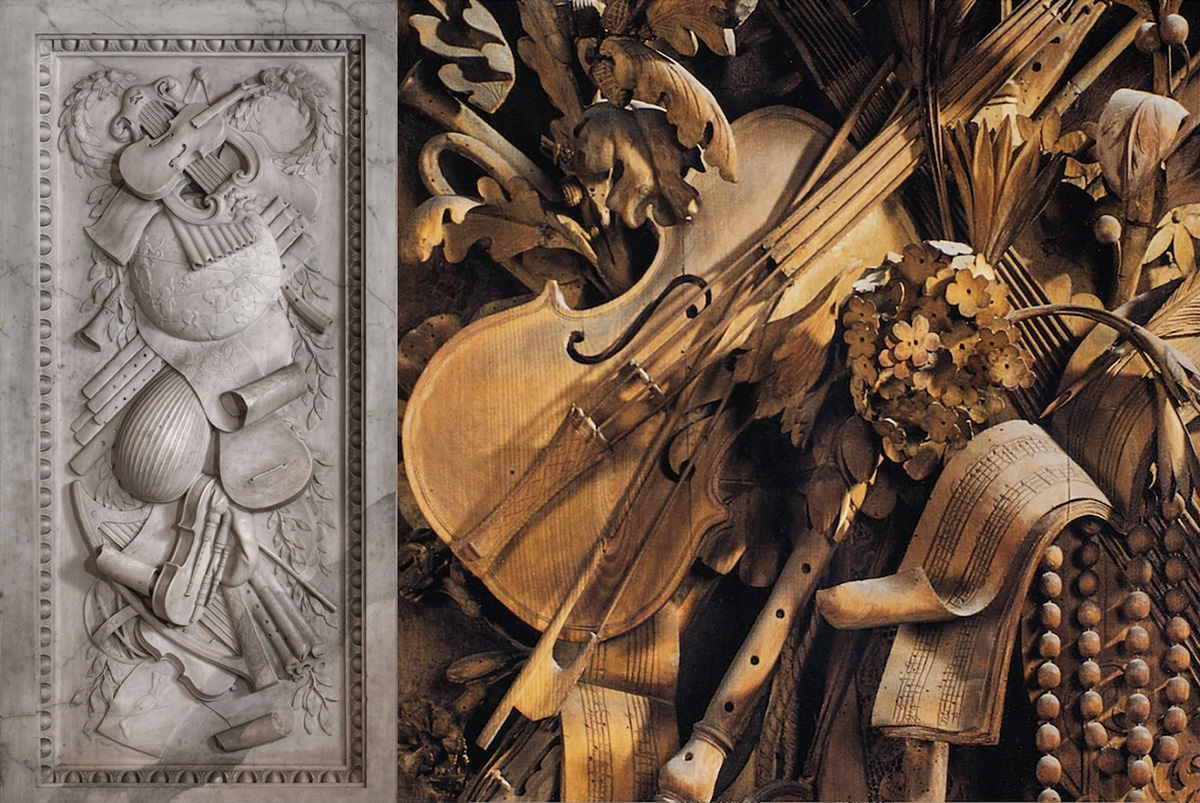
Artus Quellinus’s marble violin had no strings. Grinling Gibbons managed to carve them in limewood.
Wikipedia even states it quite firmly. Grinling Gibbons (1648–1721), born in Rotterdam, was a pupil of the Antwerp-born sculptor Artus Quellinus. Supposedly, he even worked alongside Quellinus during the years the Flemish master was creating the sculptural decoration for Amsterdam’s City Hall, now known as the Royal Palace on Dam Square.
Artus Quellinus (1609–1668) was the foremost sculptor of the Southern Netherlands in the seventeenth century. His monumental decorative programme for Amsterdam’s City Hall became one of the great masterpieces of European Baroque sculpture. Grinling Gibbons, probably born in Rotterdam to English parents, grew up in an artistic environment where Quellinus’ influence was everywhere.
The real question, therefore, is not whether Gibbons knew Quellinus’ work, but how much he borrowed from it.
Gibbons Owed It to Quellinus
The similarities between the two artists are unmistakable. Both used lavish festoons of fruit, flowers and foliage as architectural decoration. Quellinus provided the model that Gibbons later carried to Britain, where he found wealthy patrons and commissions from churches and the English aristocracy.
Both artists pursued an extraordinary degree of naturalism. Their garlands appear to hang effortlessly from the architecture, as if they had only just been draped in place. In both cases, sculpture and architecture become a single artistic whole.
The differences, however, are just as important.
Quellinus worked primarily in marble. His ornaments form part of a disciplined Classical architectural scheme in which the human figure remains central. The garlands support allegories and monumental sculptural compositions.
Weightless in wood
Gibbons, by contrast, chose limewood, allowing him to achieve a far greater level of refinement. His spectacular cascades of flowers, shells, musical instruments, birds and game seem almost weightless. They often project away from the wall, creating dramatic shadows, while the ornament itself becomes the principal subject.
Gibbons certainly adopted Quellinus’ Baroque vocabulary, but he pushed it much further because limewood allowed for an astonishing degree of detail. He carved flowers on slender stems that seem to sway in the wind. His work even approaches illusionism. How was he able to undercut his carvings so deeply that leaves and flowers are sometimes connected by only a few millimetres of wood? How could he make layer upon layer of ornament appear to float in space? And how could he deliver a carving showing peas still enclosed within a closed pod, only to cut the pod open after receiving payment?
But imitation it is not
This technical virtuosity has scarcely any equivalent in Quellinus’ work. The carved violin strings are perhaps the finest example. In marble, such delicate connections would simply snap; in limewood they could miraculously survive.
That is why I have no hesitation in arguing that Grinling Gibbons learned from Artus Quellinus. Yet imitation is not the right word. Art historians would rather speak of influence, artistic succession, or inheritance.
Jan Bom, 21 July 2026