The Summer Academy in Val Gardena asks almost the impossible of twenty young artists and their mentors. Carving a wooden sculpture in two weeks means working incredibly hard. Stressing. It applies both to the participants and to the organizers and mentors: the cousins Aron and Gehard Demetz, Peter Demetz, and Hermann Josef Runggaldier. And yet, it is a Valhalla.
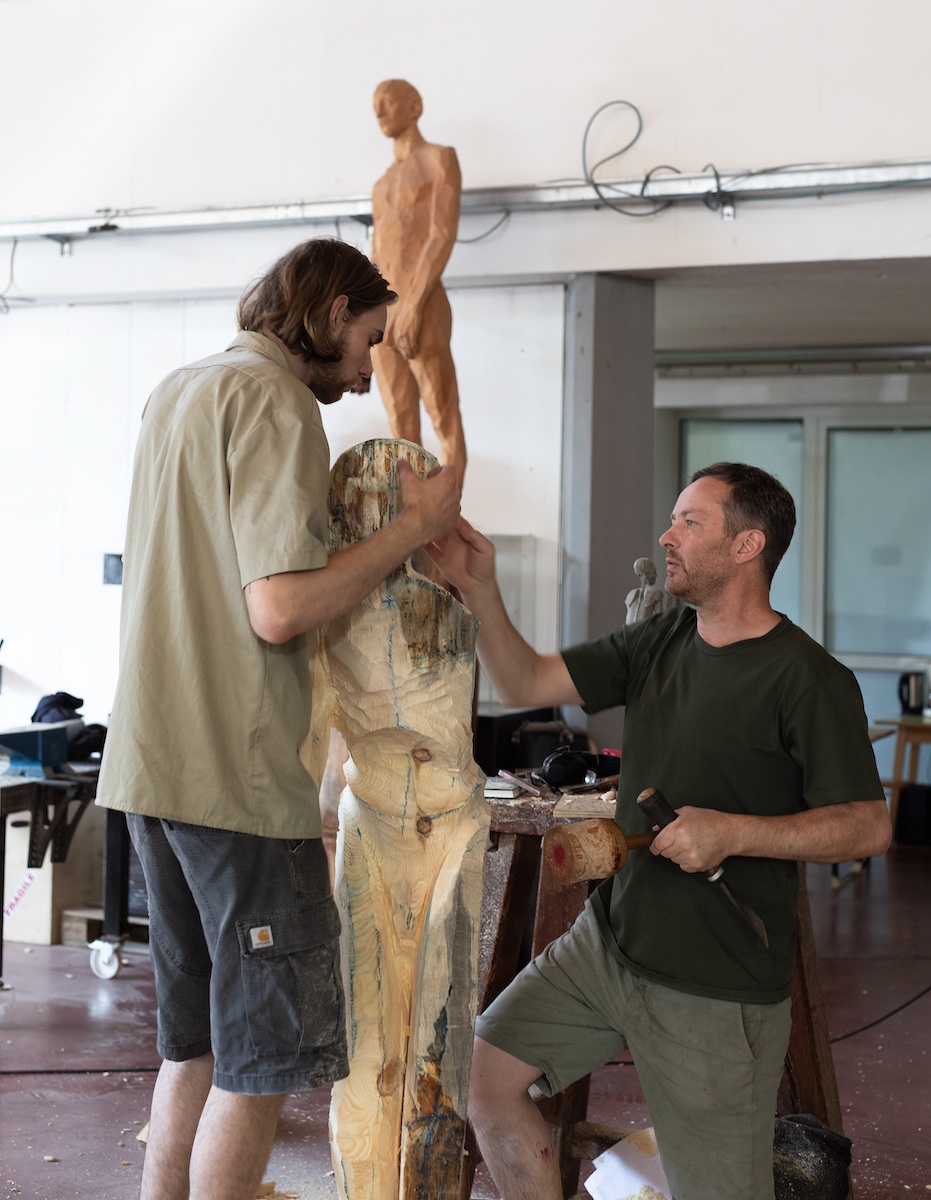
The Summer Academy in Val Gardena, docent Aron Demetz helps one of the participants.
Val Gardena is a paradise for anyone who loves woodcarving. In all the villages of this beautiful valley, you find shops filled from floor to ceiling with wooden saints, angels, crucifixes, Madonna’s, but also golfing clowns, flower girls, and rosebuds.
Made by machines
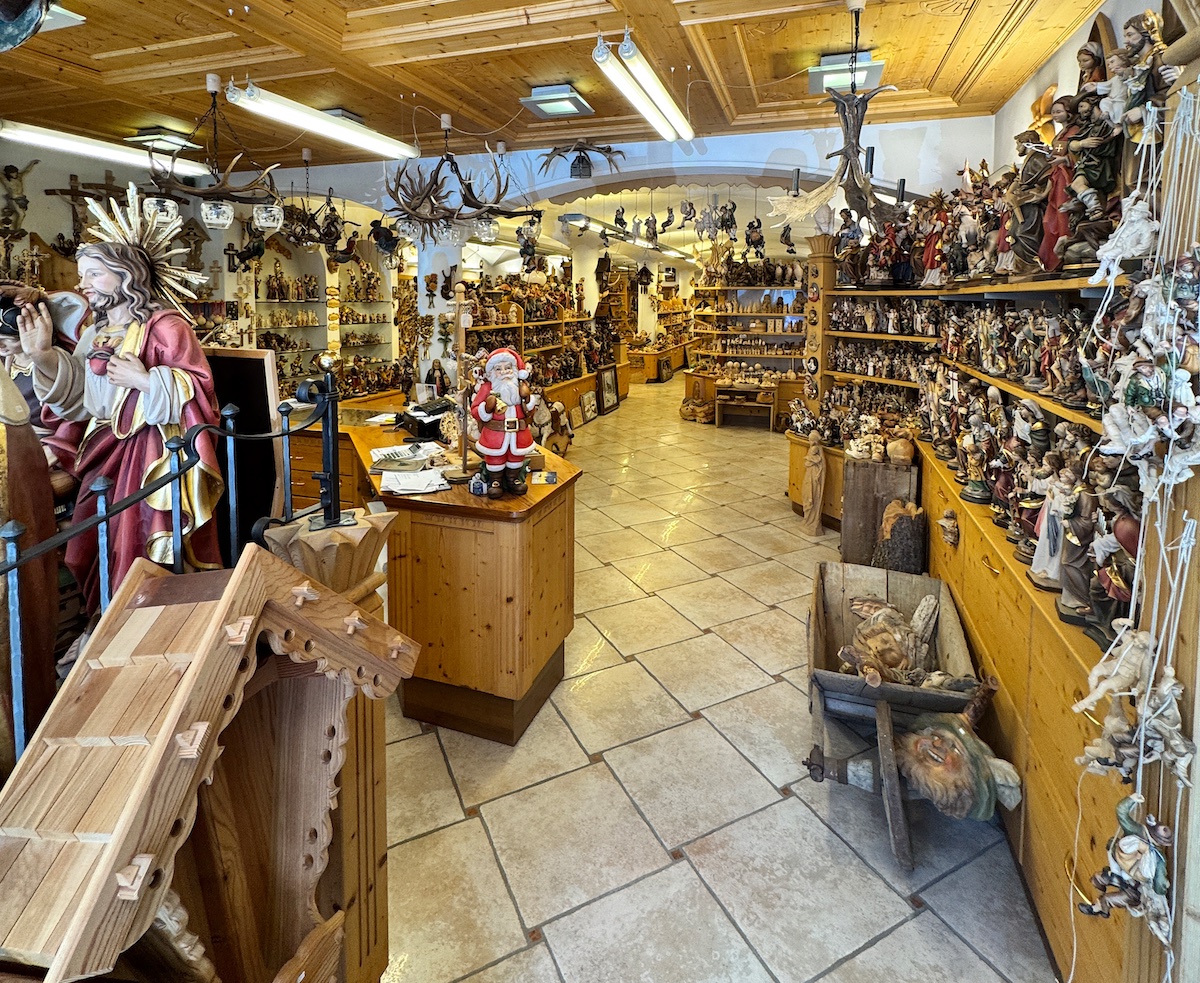
The many woodcarving shops for tourists in Val Gardena are filled with kitsch.
The shops do not seem particularly busy, despite the fact that the summer tourist season in South Tyrol, Italy, is in full swing. The streets are full of people walking by in professional hiking boots or riding expensive mountain bikes. Could it be because of the high level of kitsch in most of the little sculptures? Or because tourists sense that the figures are so polished that they have been carved by machine? And are then merely given an impeccable coat of paint by human hands?
It is a major concern in Val Gardena. Especially because most young people are no longer very interested in continuing the centuries-old tradition of their grandparents. It is much easier to make money as a ski instructor or in one of the many other jobs in the tourism sector.
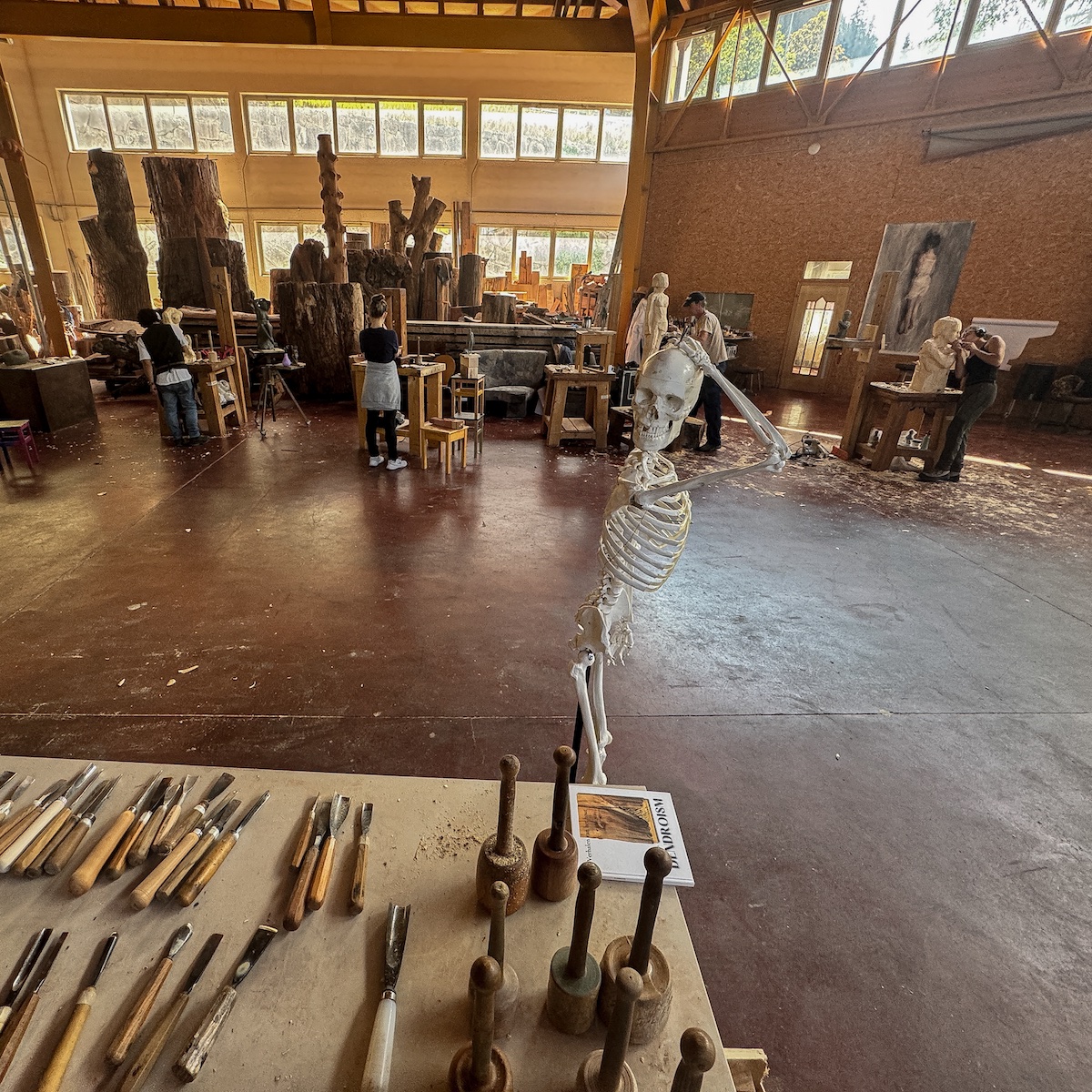
The Summer Academy in Val Gardena, in the spacious workplace of Aron Demetz.
And yet, right now, an entire generation of woodcarvers from villages such as Ortisei is enjoying international fame. Starting from the figurative tradition, each of them has developed a distinctive style and subject matter. They sell their remarkable work to art galleries in New York, Germany and at art fairs such as Art Miami. Their work has even been featured in articles in The New York Times.
But most of these world-class artists are already well into their careers: at fifty-something, cousins Aron and Gehard Demetz are still among the youngest. The irony is that, so soon after the international breakthrough of Val Gardena’s woodcarving, the community is deeply concerned about the continuity of its craft. How can the tide be turned?
Bargain price of 400 euro
Could a two-week Summer Academy help? Val Gardena certainly hopes so, and the region has been heavily subsidizing the initiative for nine years. For the bargain price of €400, twenty selected artists can spend two weeks learning what it means to work in wood under the guidance of leading Val Gardena artists: in limewood, but also in wonderfully fragrant stone pine, which grows high in the mountains, up to the tree line.
Most of them are young, still studying or even teaching at art academies. They fly in from the United States and Poland for this unique opportunity. From the Netherlands, Boris Paval Conen made the journey. He is a film director who also carves wood, creating sculptures in the tradition of Val Gardena. He could have been born here.
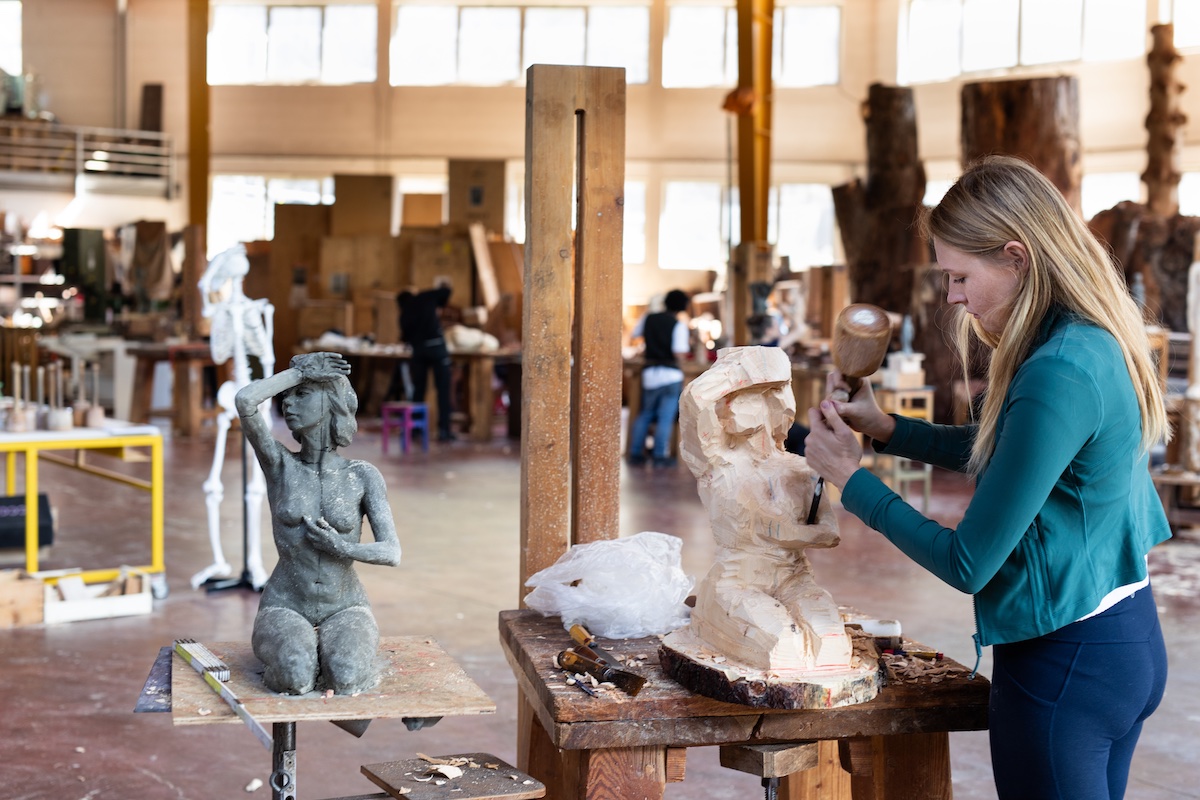
One of the 20 participants, with the result after five days hard work.
And so, on this summer day at the end of July, the sound of woodcarving chisels and chainsaws fills the spacious studio of Aron Demetz in the industrial enclave of Pontives. After a first week of hard work, half-finished figures are already beginning to emerge, standing alongside clay maquettes. Everyone is under pressure.
Gehard Demetz, who himself used to teach at the woodcarving school in Val Gardena, admits that he is exhausted after that first week. “You have to immediately figure out what each participant wants. And then convey the technique. Almost everyone starts removing too much wood. Woodcarving is new to most of the participants, who are used to building up their sculptures with clay.”
Human figure as a starting point
The Summer Academy remains rooted in the tradition of Val Gardena. That means the human figure is the starting point. A skeleton in the middle of Demetz’s studio serves as a model for proportions, posture, movement, and anatomy.
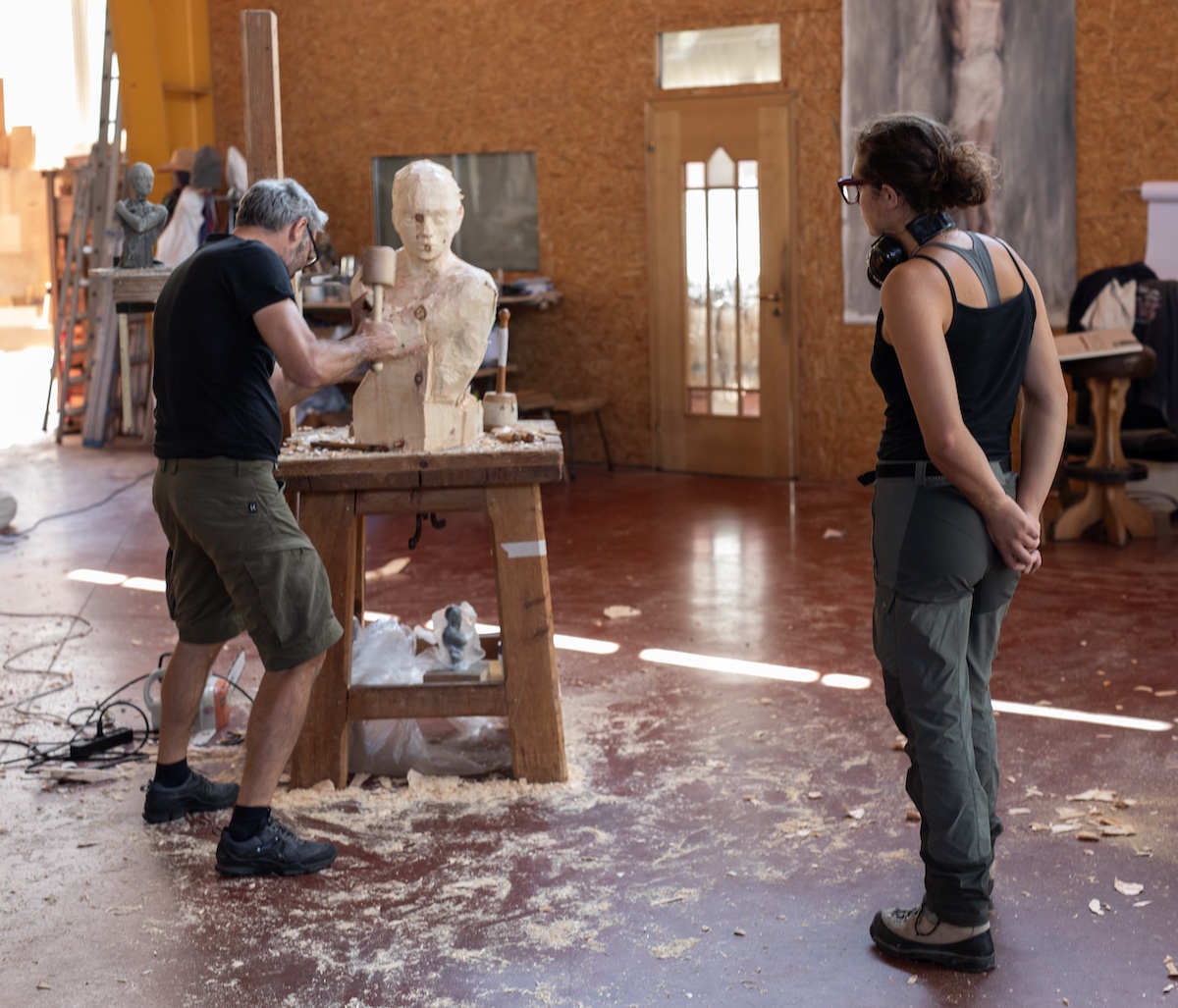
Gehard Demetz picks up a gauche and suddenly the magic is there.
But the aim is not simply to develop technical skills. The participants are challenged to develop their own visual language and to look critically at their work. In that sense, the sculpture actually begins before the first chisel touches the wood. During the first five working days and half a Saturday, the hall is filled with an atmosphere of feverish concentration.
Measurements are taken, and then taken again. One participant takes ten steps backward to stand at eye level with her bust. When despair sets in, Gehard, Aron, and the other instructors pick up the appropriate gouge and lend a hand. These are moments of magic: with a few well-placed blows, the desired line of the neck suddenly appears.
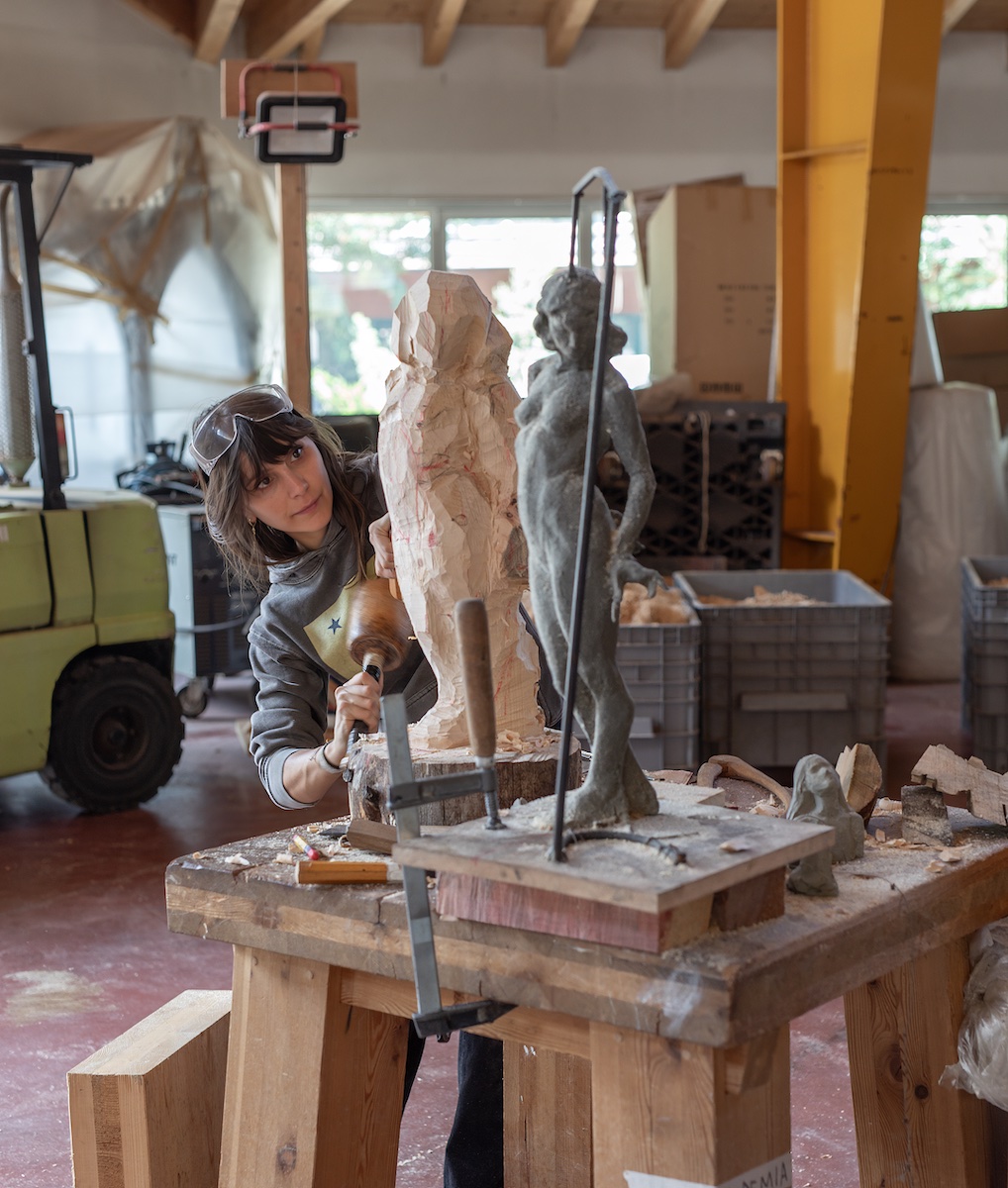
The participants with sculptures in modest size get the furthest.
The most sensible, perhaps, are the female participants who have kept their sculptures modest in size. They get the furthest. Carving and finely finishing a life-size figure is extremely ambitious within the time frame of the Summer Academy. The sculpture has to go home with them, where, without the watchful eye of the Demetzes, they can use rasps and sandpaper to create the smooth skin that characterizes sculptures from Val Gardena so strongly. It is the legacy of a practice that once began with making wooden dolls. Which, of course, had to be free of splinters.
Tradition and experimentation
For Aron, giving up his studio for two weeks is also an act of idealism. He considers the international character of the Summer Academy important. The exchange is not one-sided: the participants also bring their own experiences and ideas. In this way, his studio becomes a meeting place for tradition and experimentation. The local sculptural tradition of Val Gardena is always present, but no one is expected to continue it literally.
Jan Bom, 15 August 2026