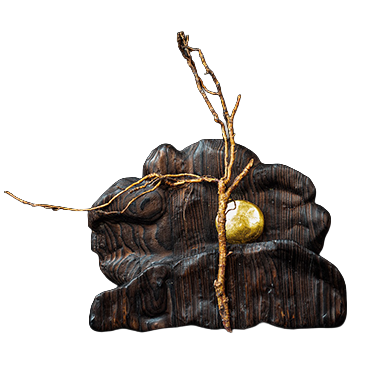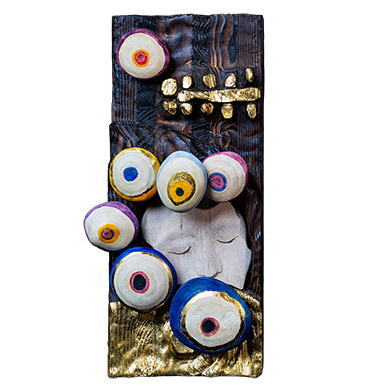
Gregor Prugger opens his treasure chest, high in the Dolomites of South Tyrol, Italy. In an ancient farm barn, he keeps a lifetime of ideas: radical and boundary-pushing woodcarving. Increasingly, he has allowed the trees themselves to determine the forms of his art. Prugger is, for me, the king of Dendroism: he even lets branches literally write their own stories on paper.
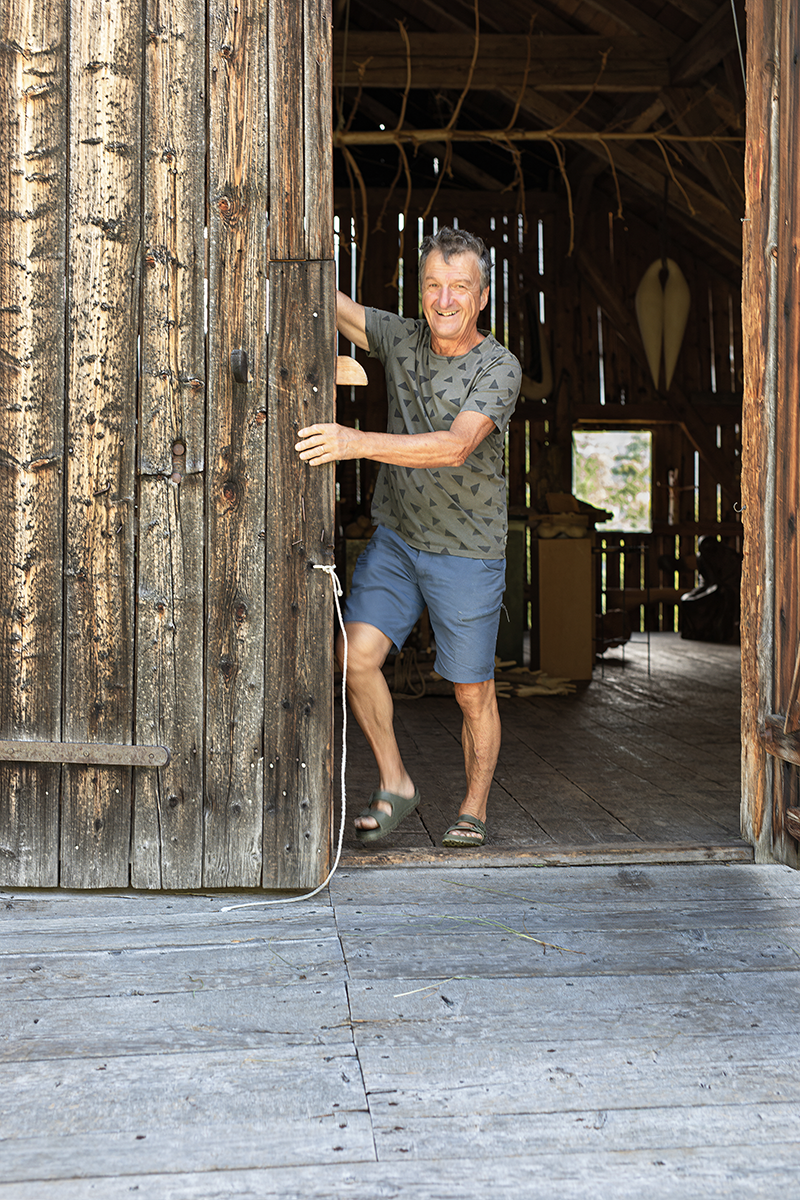
Gregor Prugger opens his treasure chest, high up in the Dolomite mountains.
Until recently, in winter Prugger still walked up the steep mountain road twice a day to his ancient ‘Bauernstadel’ Hof Pilat, high above his hometown of Ortisei in Val Gardena. A steep walk of 45 minutes. His goats and two donkeys had to be fed, after all. Until the walk became impossible after knee surgery. He had to sell his animals, with a heavy heart.
I am a free bird
Now he leaves his summer residence, which has been in the family for 90 years, only in a four-wheel-drive vehicle. But when his wife wants to go to the sea in the July heat, he does not go with her. Up here, beneath the sharp peaks of the Dolomites, he finds everything that makes life worthwhile. He still works on new artworks here, looking out over the Val Gardena valley from his studio. “I want to be free,” he says. “I am a free bird. I can make whatever I want.”
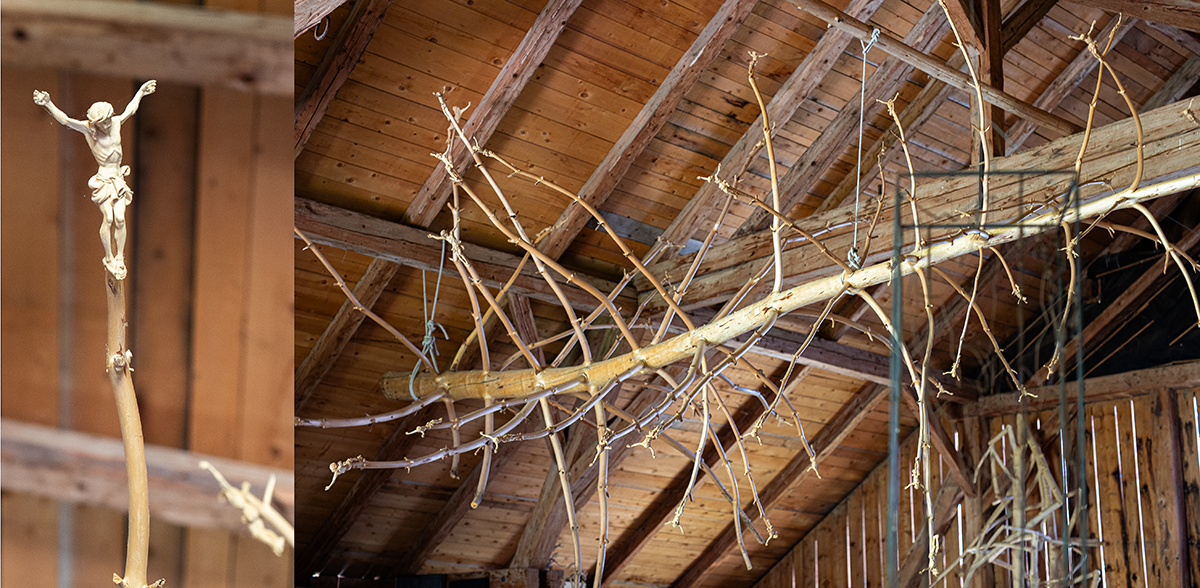
Gregor Prugger opens his barn, and the first thing you see hanging in his treasure chest is a ‘Christ Tree’: Christ-Baum from 2014.
Sun, snow and rain have turned the tall, heavy barn doors almost black. When Prugger opens them, the first thing that catches the eye is a stripped, pale tree trunk reaching up towards the high roof. At the end of every branch, he has invisibly attached a figure of Jesus, in the position in which the Romans nailed him to the cross.
The figures are unique and beautifully carved, rooted in the tradition of the woodcarvers of Val Gardena. Prugger learned this tradition at home, in his family’s woodcarving workshop. His grandfather was a woodcarver, as was his great-grandfather. But after completing the Fachschule for woodcarving, Prugger continued his education and studied at the art academy in Florence. A traditional training, but Prugger soon freed himself from the imitation of classical examples.
Weeping Mary
Beneath his ‘Christ Tree’, he keeps another work from that period: a self-portrait. It is a bust, but with a twist: Paura from 1987. Carved from Zirbe, the fragrant pinewood, it shows the half-naked young Prugger staring intently at the world, with glass eyes. This too is an old tradition, although the technique was mainly used for images of the Virgin Mary.
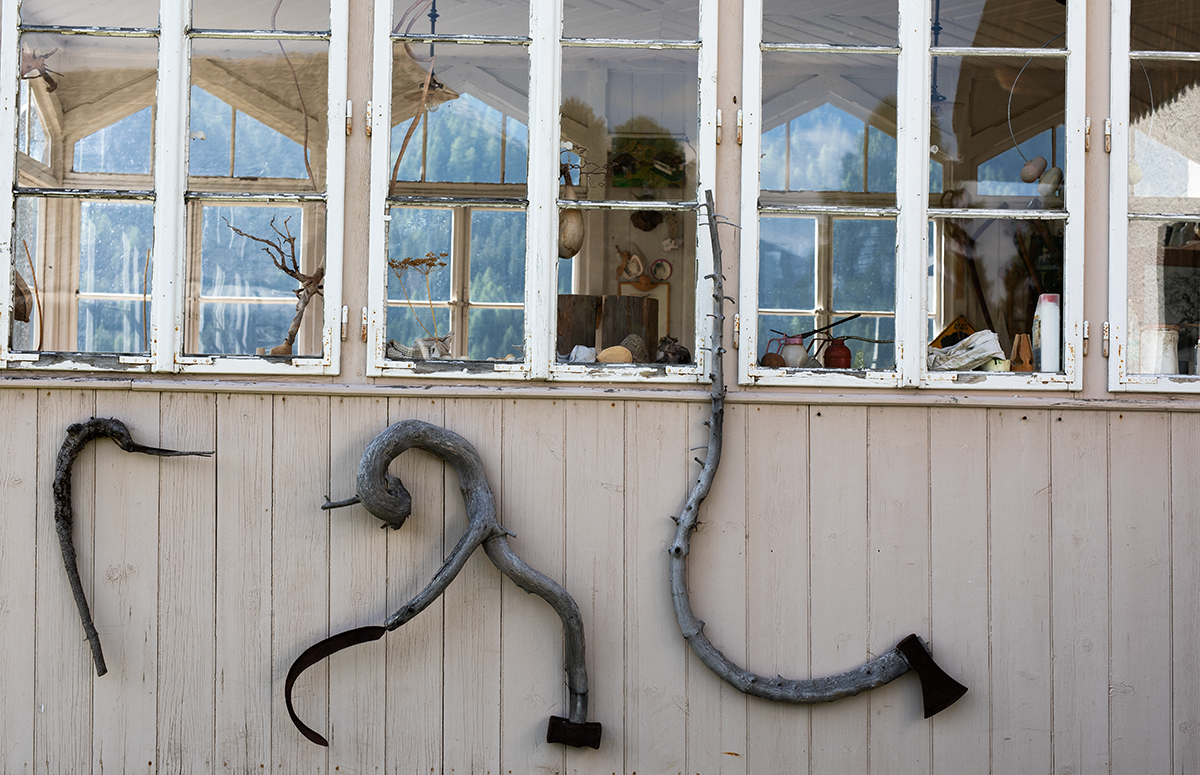
Gregor Prugger’s atelier, filled with old tools with naturally shaped wooden handles.
Prugger tells the story of the technique with great amusement: “To make this work, you have to saw off the face and hollow out the eyes from the inside. You place the glass spheres with the coloured eyes in a layer of wax. This allows you to adjust the eyes, so Mary doesn’t look cross-eyed at you. After sealing it with plaster you glue the face back onto the back of the head. But if a sculpture like that was placed somewhere warm, the wax would sometimes melt. Then a tear would occasionally appear beneath her eye. A miracle, people thought. Mary is crying, haha.”
The victims of the Mafia
In 2022, he created a new version of the ‘Christ Tree’, which he called L’Albero dei Tutti — literally, ‘The Tree of Everyone’. This time, instead of Jesus, he attached 174 wooden sculptures to the branches, as symbols of the victims of the Italian Mafia. He created the work to mark the thirtieth anniversary of the 1992 Mafia attacks, including the assassination of anti-Mafia prosecutor Giovanni Falcone in Sicily.
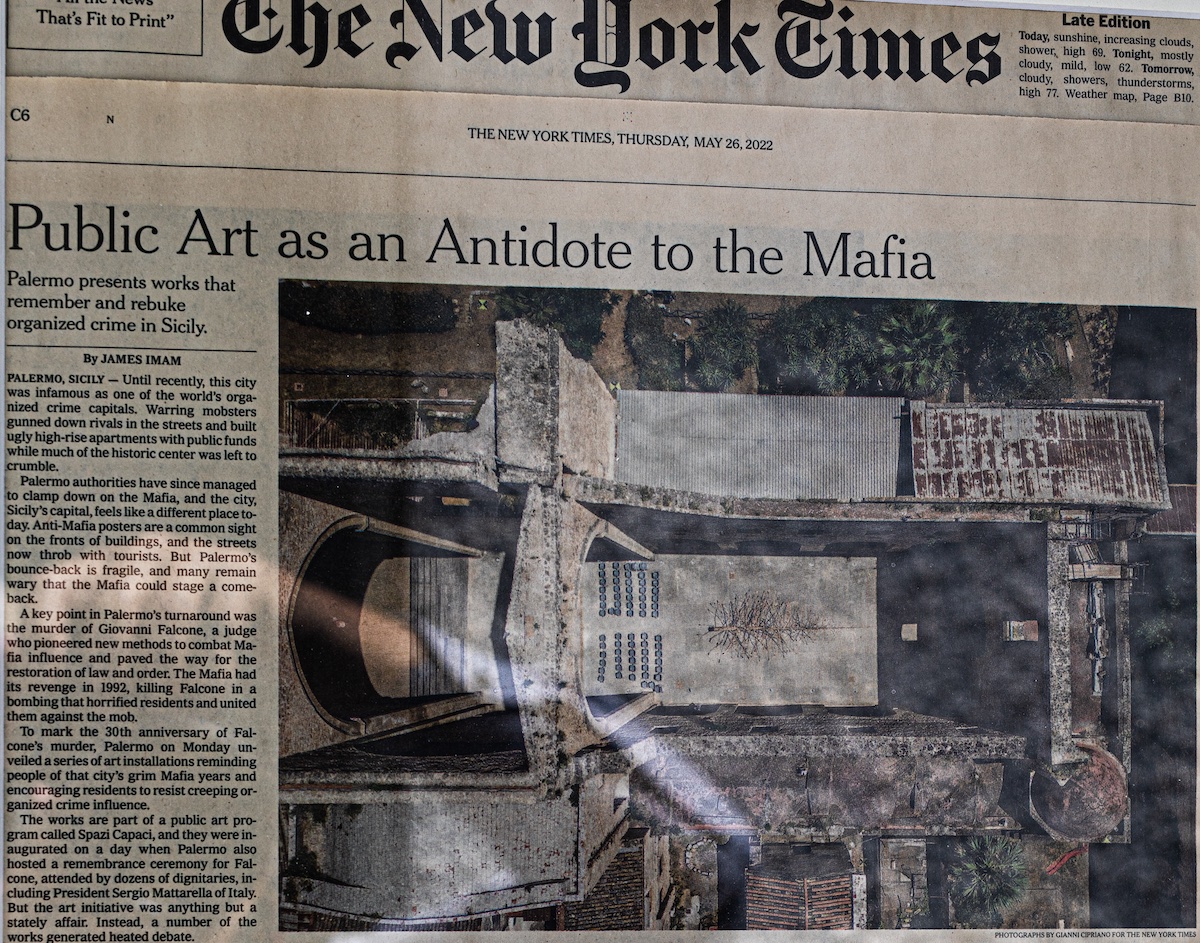
A page from the New York Times shows an aerial photograph of Prugger’s memorial tree in Palermo, Sicily.
Prugger shows us a framed page from the New York Times, featuring an aerial photograph of the 15-metre-long tree. He is proud of this international recognition. But he also tells us: “When the exhibition was over, dozens of little sculptures had been cut from the branches. People said that the relatives of the victims had done it as a keepsake for their loved ones. That would be nice, but I don’t know whether it’s true.”
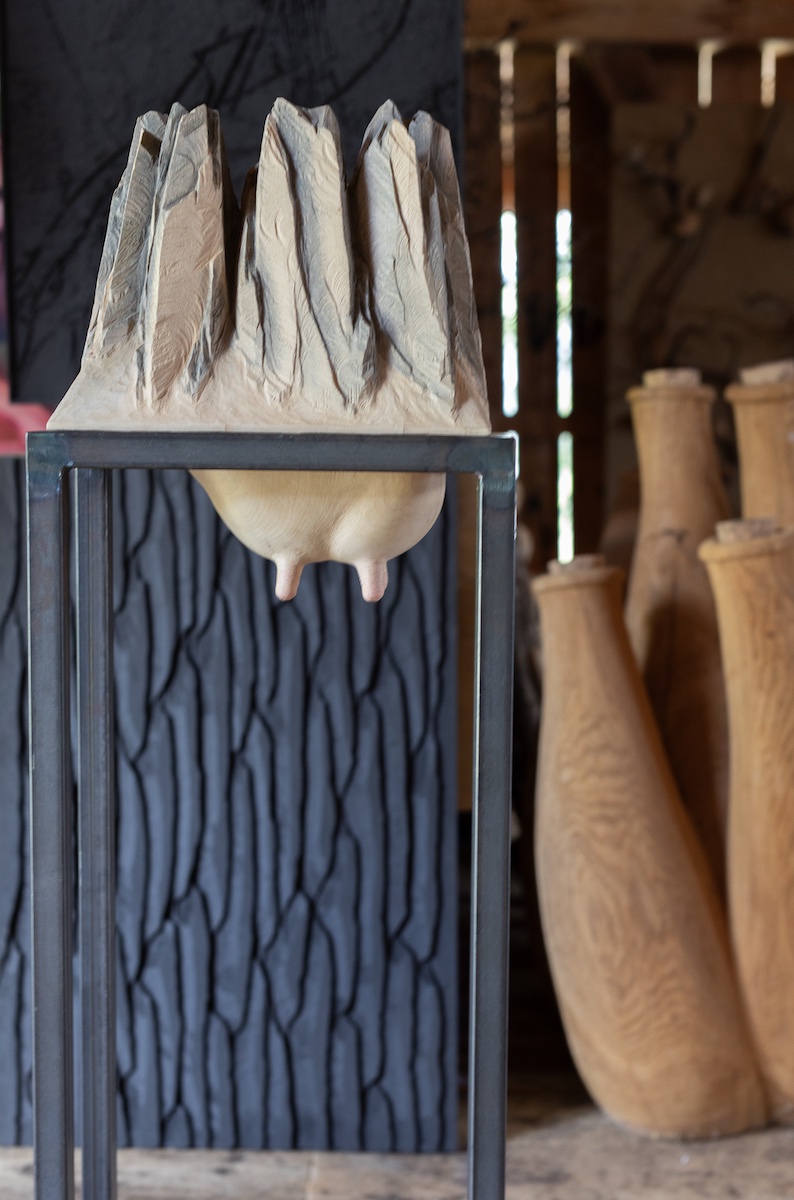
An installation by Prugger criticises the tourism that is damaging the idyllic world of Val Gardena.
Tragedy and humour alternate in his enormous treasure chest, a museum of his lifelong experiments. He made an installation, for example, whose upper section shows the characteristic sharp peaks of the Dolomites. Beneath the mountains hangs a full cow’s udder. “Because tourism is milking our mountains,” Prugger explains.
Next to it lies a bundle of branches, tied together, with roughly carved hands at their ends: Syria from 2015. “Made for all the victims from Syria who drowned on their way to Europe.”
The silhouette of snow
Also striking are the many wooden reliefs Prugger has carved, not only of mountain landscapes but also of more abstract subjects: rain, snow. Somewhere on the spectrum between art and design, they tend towards the latter. Interior designers would probably love to have more of his work. Highly marketable pieces.
But Prugger said goodbye to his gallery owner. “I can’t make what I want anymore. The gallery owner sees what sells well and then tells me: You should make more chairs. But no, I feel like making a table.”
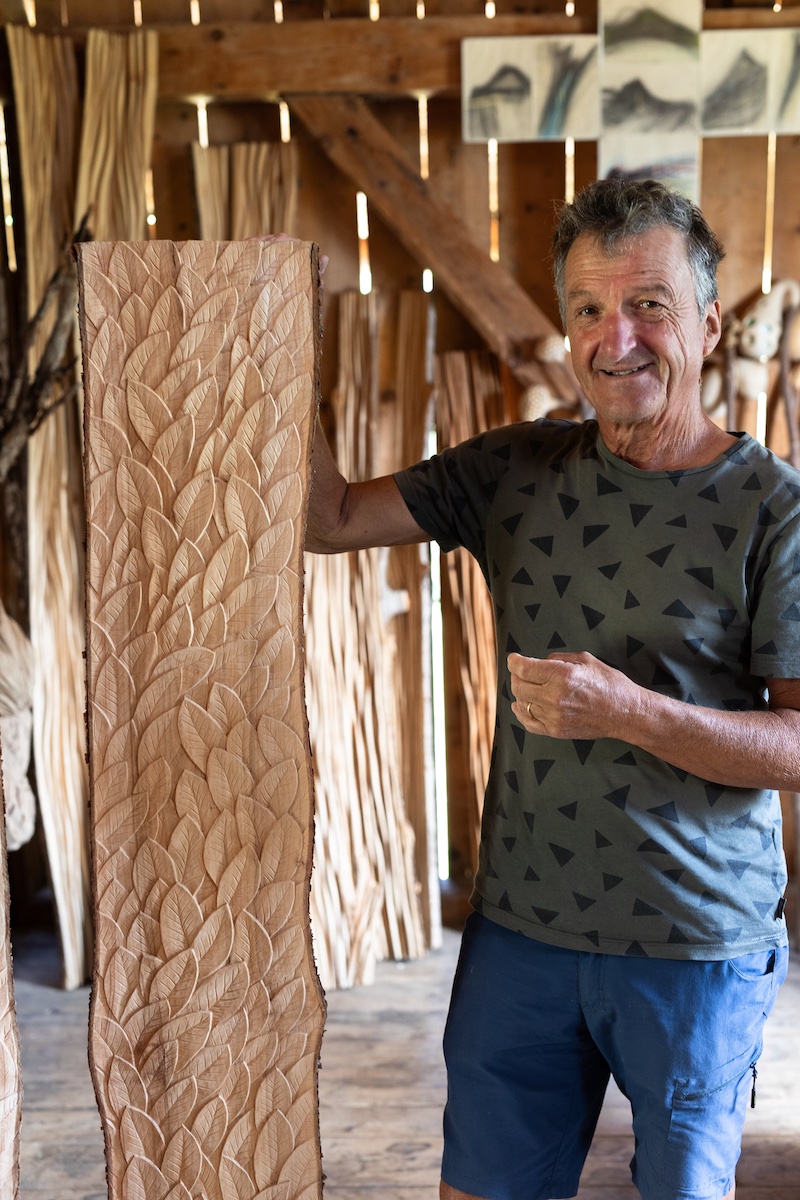
Prugger beside a tree trunk on which he carved a beautiful relief of leaves.
That is why his artwork Prima di sbocciare from 2012 remains in his treasure room. It is a man-sized tree trunk, split in two, which Prugger meticulously covered with a relief of leaves. His poetic explanation: “Because after falling, the leaves return every spring. They are hidden inside the trunk during winter. I have made that visible here.”
Branches that draw by themselves
And then Prugger shows us another extreme, a much more conceptual work: branches that draw by themselves. Wood continues to respond to its surroundings even after a tree has been felled. Because of changes in temperature and moisture, it shrinks and expands. Prugger made this movement visible by attaching pencils to the ends of gnarled branches. Now, a few years later, the branches have produced drawings of their own movements.
Fascinating. It is hard to imagine a better example of Dendroism. For me, Prugger is the king of Dendroism, the artistic attitude based on the idea that trees have stories of their own to tell. After I explain the idea behind Dendroism, Prugger nods in agreement. Yes, he says, that describes very well what he has been doing in his work in recent years.
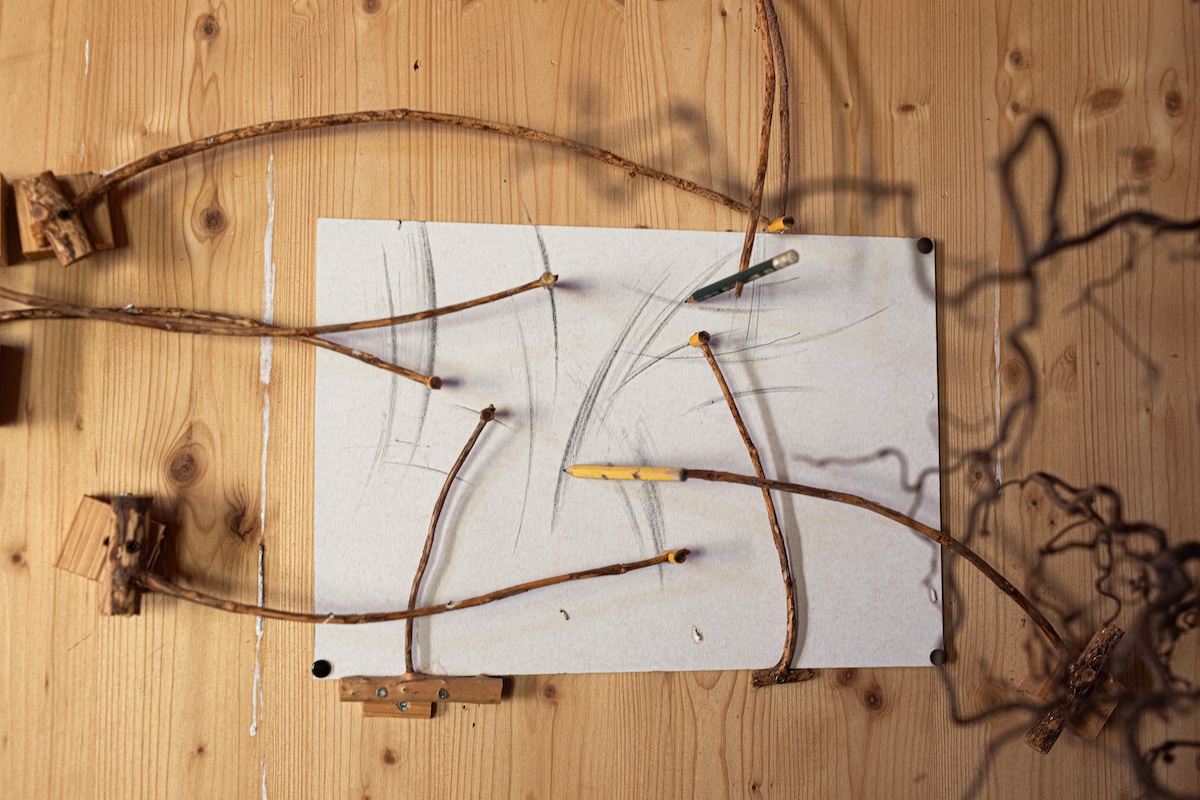
Prugger made the life of branches visible by letting them make drawings.
It is an overwhelming harvest from a lifetime of work. Before Prugger pours us a glass of wine, there is one more cheerful surprise. He shows us a sculpture and asks what we see in it. The answer seems fairly obvious. It is a silhouette made up of breasts. Right? Once a Madonna in the tradition of Val Gardena, now a symbol of motherhood.
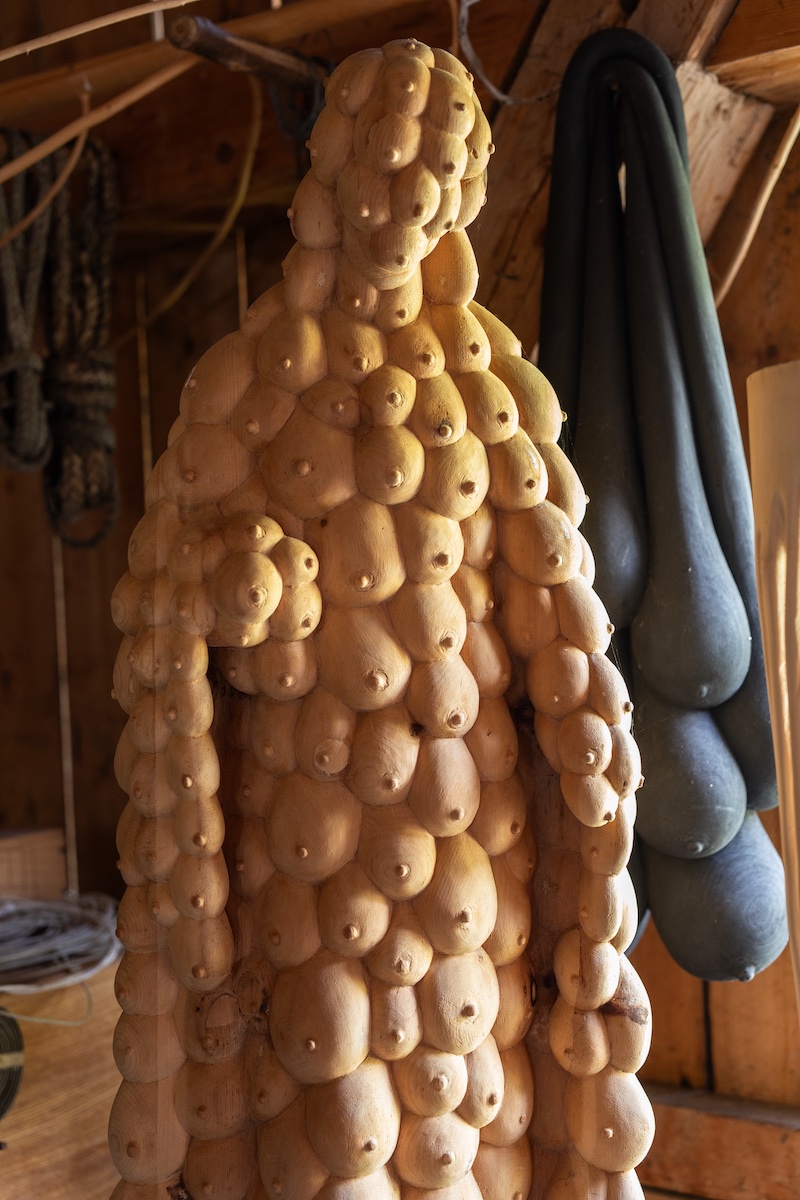
Once a Madonna in the tradition of Val Gardena, now a symbol of motherhood.
Prugger confirms our answer. Correct. But did we know that this sculpture was once carved by his grandfather? And that at the time it clearly represented the Virgin Mary, the Madonna? “I have clarified the meaning of Mary somewhat, as a symbol of motherhood.”
We sit on his terrace, looking out over the valley far below us. An elderly hiker has settled into one of the wooden chairs designed by Prugger. “I know this man. He climbs up here to drink the water from the mountains. He says it makes him stronger. He may well be right. He comes back every year.”
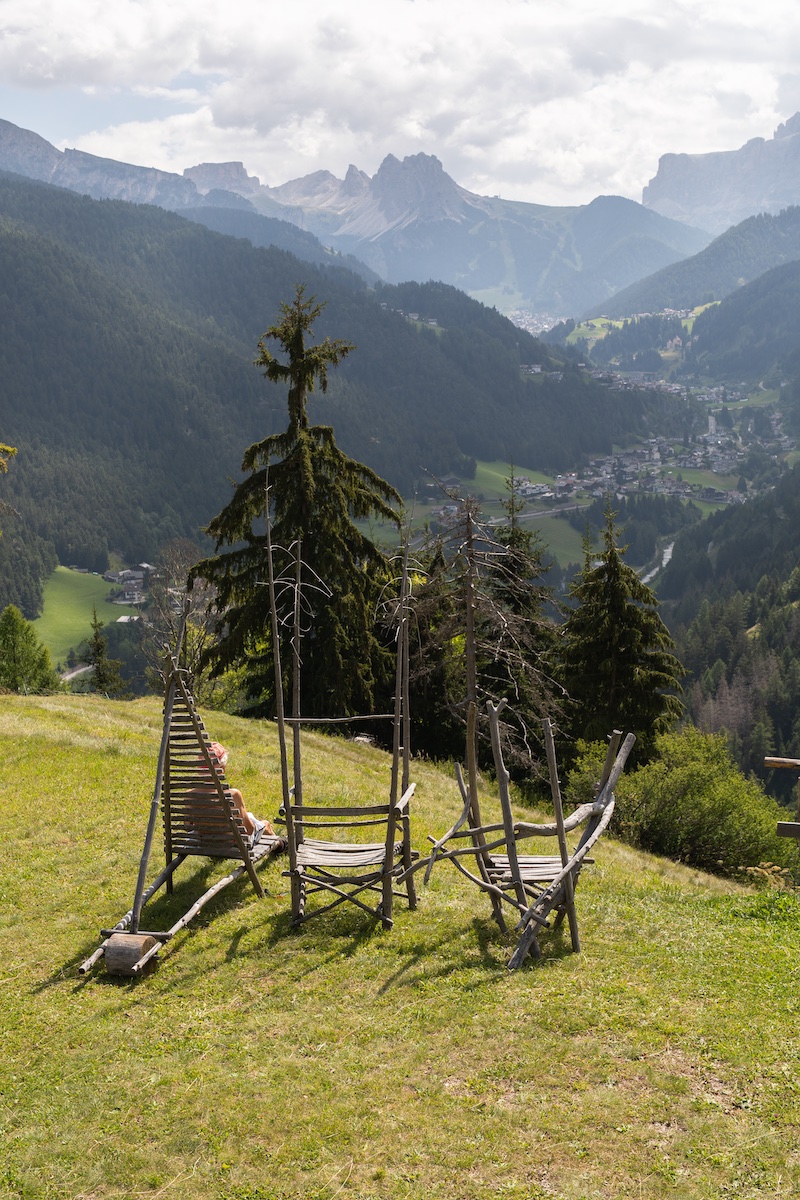
The chairs made from branches offer a magnificent view over Val Gardena
The sun is shining. It is very quiet up here. Life is good. How sad that it is finite. What will happen to Prugger’s treasure trove of ideas later on?
The artist does not seem concerned.“Another beautiful quality of wood is that you can use it to keep yourself warm. Put it in the stove, haha.”
Jan Bom, 17 August 2026