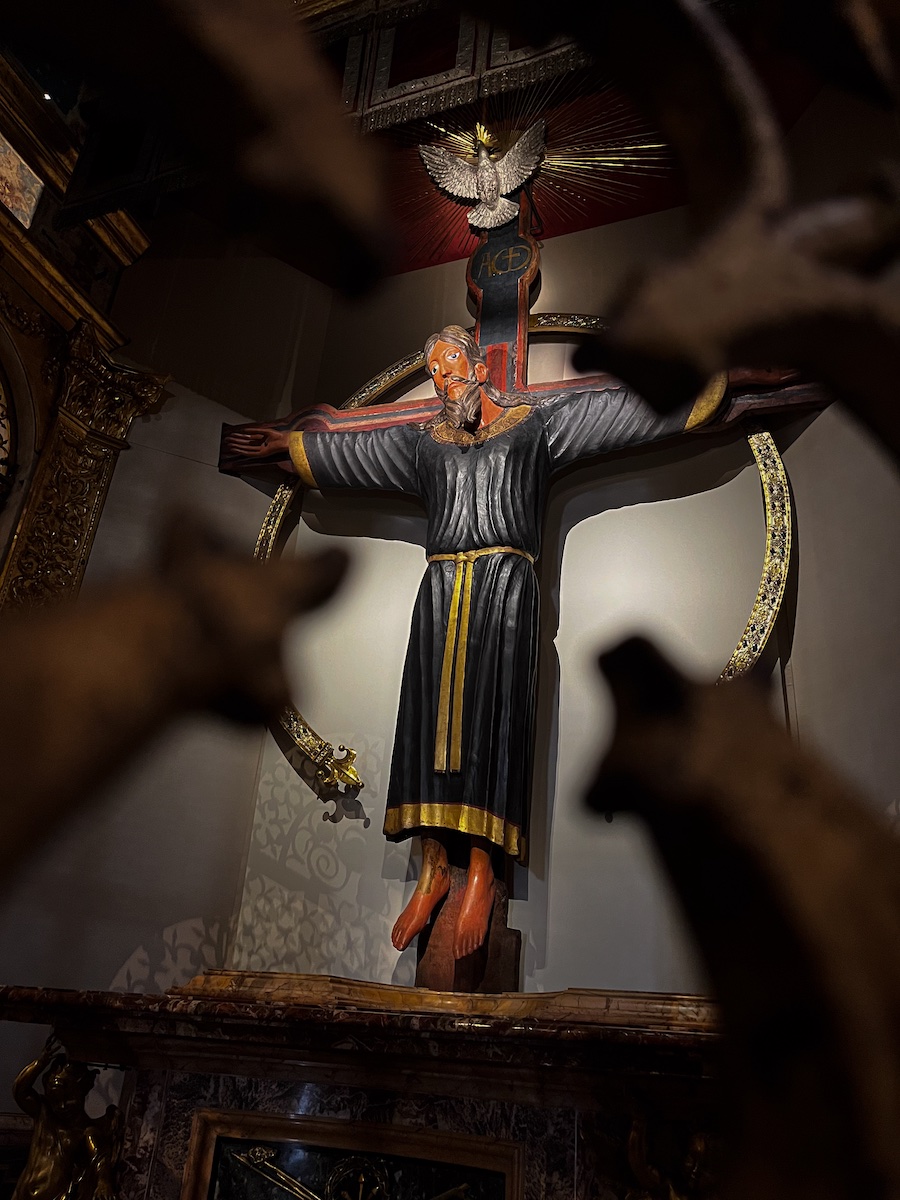
Lucca puts Europe’s oldest wooden Jesus behind an iron screen. What a pity. Those bars were an irritation and, for me, slightly spoiled the visit to the beautiful Cathedral of San Martino. He is hidden away: one of Europe’s most famous wooden sculptures, the Volto Santo, the Holy Face.
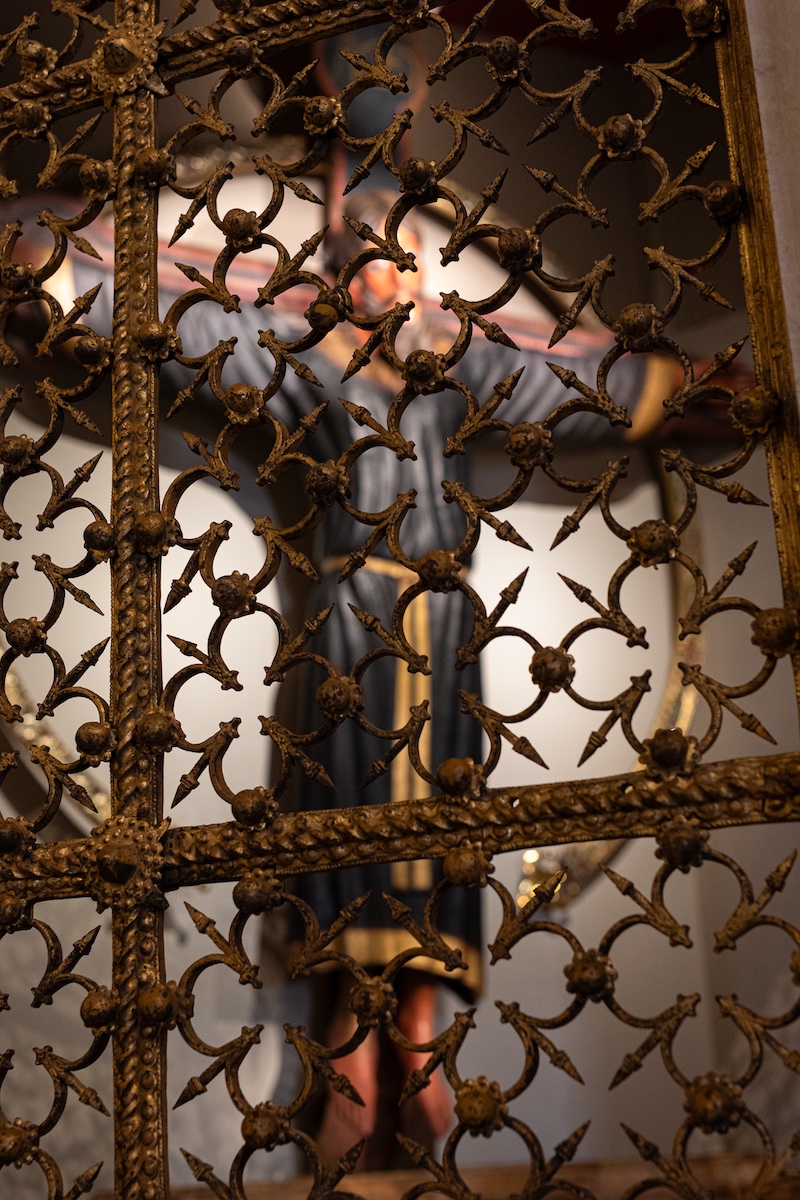
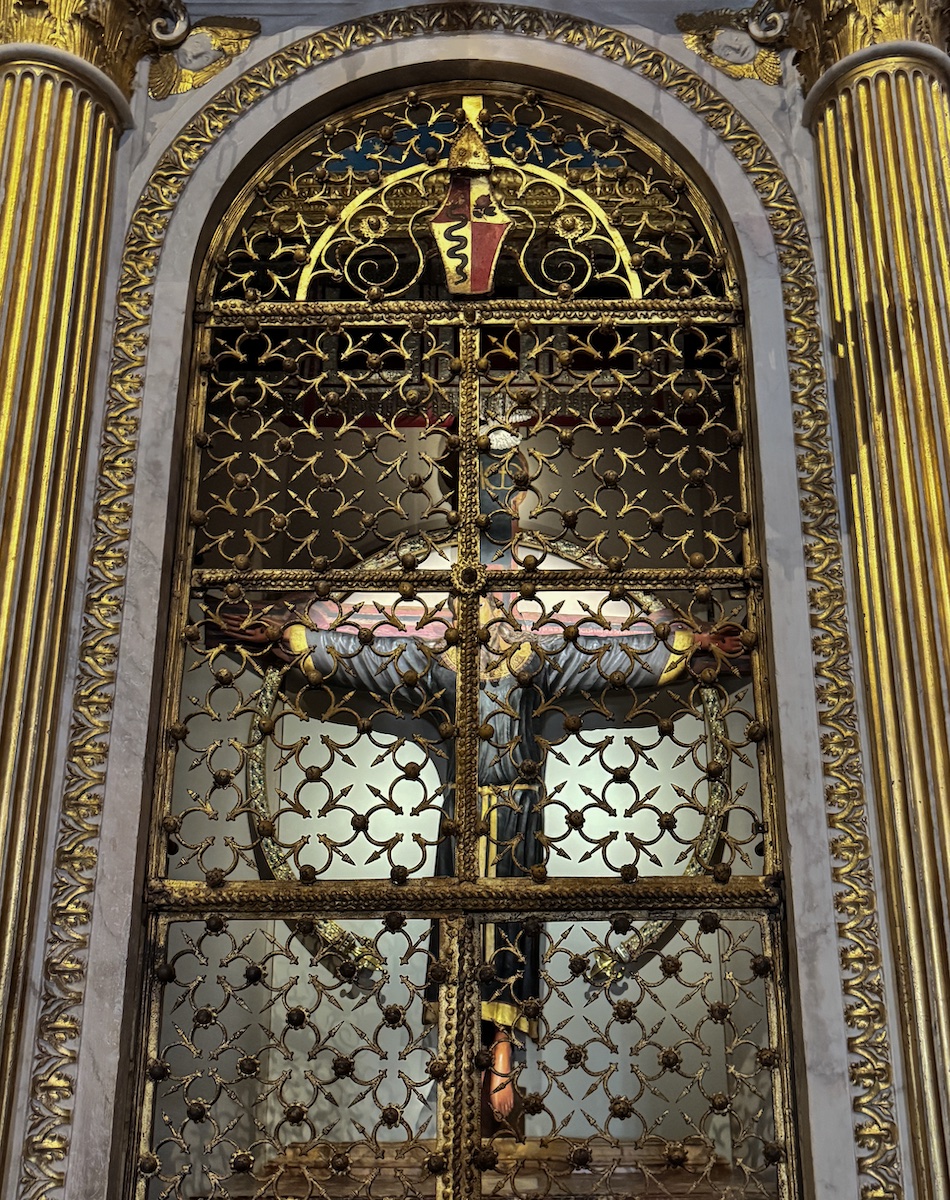
A dense iron grille obstructs tourists’ and believers’ view of this historic wooden crucifix.
The monumental crucifix is almost life-size and does not show Christ as the suffering man on the cross. Here, he is a regal, upright figure. His eyes are wide open, his expression stern, and his body is covered by a long robe. His glass-paste eyes – pasta vitrea – stare straight at you. Bright and gleaming.
Eighth or ninth century
For centuries, it was assumed that the sculpture dated from the twelfth or thirteenth century. That view changed dramatically in 2020. Carbon-14 analysis dated the wood of the crucifix to between the end of the eighth and the end of the ninth century.
More recent dendrochronological research on the wooden cross itself produced a date of around 860. The Volto Santo suddenly became one of the oldest surviving wooden sculptures in Western Europe.
The Volto Santo is old, but not the oldest wooden sculpture in Europe.
The Cathedral of San Martino has seized on this with a rather American-style marketing approach. The claim made in leaflets inside the church is that the Volto Santo is ‘the oldest wooden sculpture in Europe’. That simply isn’t true.
Take the ‘Little Man of Willemstad’ from the Netherlands. This small oak figure is no more than 12.5 centimetres tall, but it was carved around 5400 BC. It is almost 7,500 years old, making it more than 6,000 years older than the Volto Santo. It was discovered in 1966 during the construction of the Volkeraksluizen, deep underground, where it had been exceptionally well preserved thanks to the wet environment.
Dutch sculpture is centuries older
And the ‘Little Man’ isn’t even the oldest wooden sculpture. In the Russian part of the Ural Mountains, the so-called Shigir Idol was discovered: a monumental wooden ‘signpost’ dating to around 9600 BC. Scientific research regards it as the oldest known monumental wooden sculpture in the world.
Now, Russia is not considered part of Europe – certainly not today – but never mind.
The history of wooden sculpture therefore certainly does not begin at the start of our era.
Survival of the Middle Ages
So what still makes the Volto Santo special? It is, of course, an exceptionally old wooden crucifix that has survived from the Early Middle Ages. Many later sculptures have perished, damaged by woodworm or the climate.
The sculpture became an important stopping place on the pilgrimage route of the Via Francigena.
Moreover, this particular image of Christ had an enormous influence on European sculpture. The unusual depiction of Jesus wearing a long robe was imitated throughout Europe. The sculpture also became an important stopping place on the pilgrimage route of the Via Francigena. In this way, it grew into the religious symbol of the Italian city of Lucca.
People still sit quietly in prayer before the sculpture in the cathedral. I am reprimanded by worshippers for still wearing my summer hat. Outside, the sun is blazing at 38 degrees Celsius.
From Jerusalem
The origins of this crucifix are equally fascinating. According to a medieval legend, the crucifix was made by Nicodemus. According to the New Testament, he was the man involved in the burial of Christ. The sculpture was then said to have been hidden in Jerusalem and brought miraculously to Italy in 782.
True or not, there are good indications of an Eastern background. The depiction of Christ as a robed, regal and priestly figure fits a Syrian-Palestinian tradition. But that does not mean that the Volto Santo can demonstrably be said to have been made in Syria.
Cedar and walnut wood
Research on the wooden cross established that the horizontal beam is made of cedar. According to the researchers, cedar was not planted in Europe until the sixteenth century, so the wood must have come from the Middle East. The researchers also suggest that this may have been deliberate because of the wood’s association with the Holy Land. But this still does not prove that the sculpture itself came from Syria. The wood may simply have been imported.
The recent restoration has shown that the sculpture itself was carved from a single enormous walnut trunk. Restorers also discovered that earlier repairs had been carried out over the centuries. Parts of the feet, for example, had been replaced, probably as a result of wear caused by veneration. Fingers had also been replaced in the past: they are vulnerable parts of wooden sculptures because they are so thin. A single woodworm can be fatal.
After the restoration, Christ looks as good as new. Personally, I found him a little too new. The sense of an ancient past has disappeared as a result.
Keep the lights on
What a pity. Because the restorers made a remarkable discovery beneath a dark, pigment-mixed wax layer and a black overpainting of the robe. Beneath all those layers, the robe was found to have originally been lapis lazuli blue. This was a precious pigment in antiquity, because the stone had to be brought all the way from Afghanistan.
If you want to see that robe, however, you have to peer very carefully through the dense iron screen. As far as I could tell, the black overpainting has remained, and even then the robe is difficult to see properly. I would advise Lucca not to lock up this historic sculpture in such an unpleasantly medieval way. And please don’t turn off the lighting above it from time to time either.
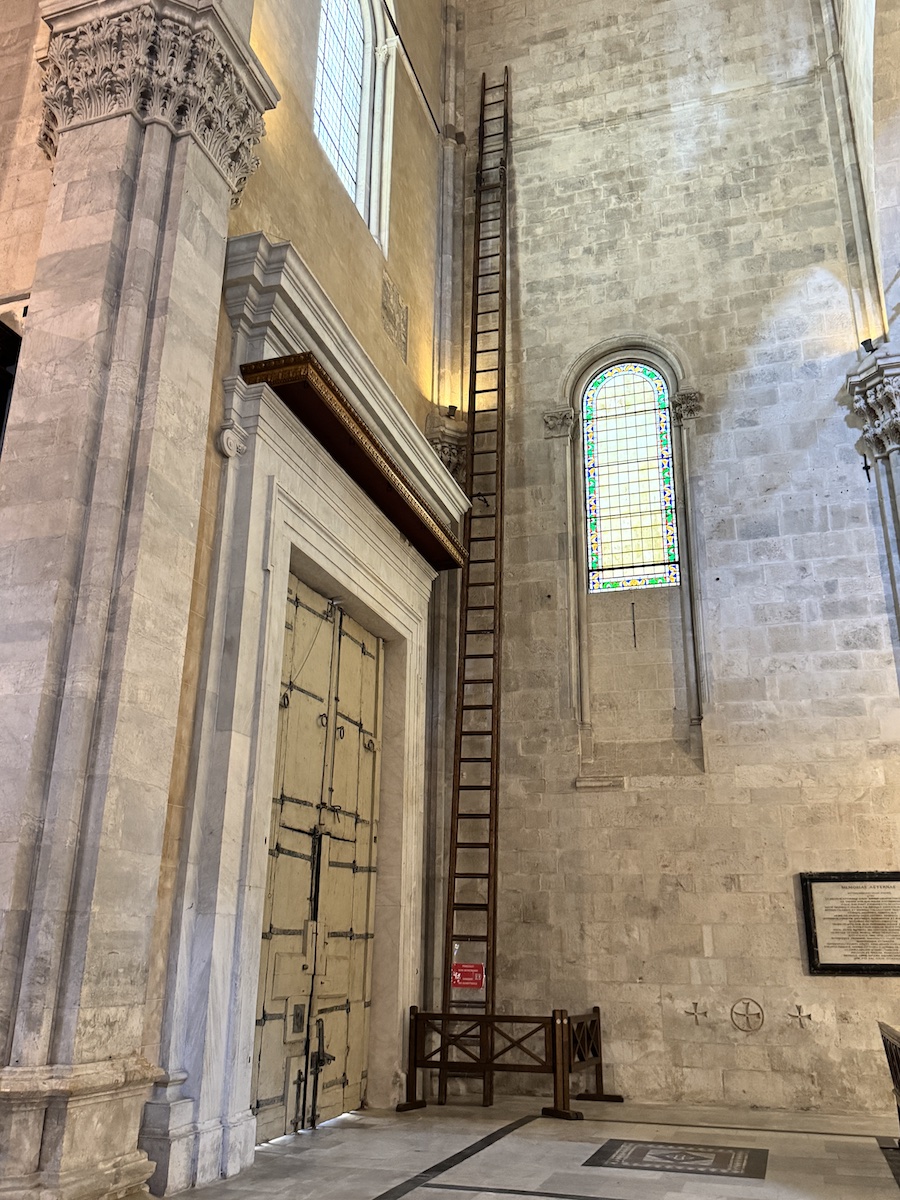
The ladder in the Cathedral of San Martino, casually propped against a wall.
I saw Donatello’s Mary Magdalene in Florence displayed in a brilliantly lit glass case, where I could walk all the way around it and admire it from every angle. That opportunity has been taken away from me with the Volto Santo.
Instead, I took my best photograph in the church of an endlessly long wooden ladder, casually parked against a church wall. Another biblical symbol. I thought of Jacob’s Ladder and Jacob’s heavenly dream. And just like that, I forgot what I had actually come to see.
Jan Bom, 18 August 2026